
pNiFty3-I-SEAP-Puro
-
Cat.code:
pnf3p-sp4
- Documents
ABOUT
IRF-inducible reporter plasmids - mIFN-β promoter - Puromycin resistance
InvivoGen has designed pNiFty3, a collection of inducible reporter plasmids, to monitor pattern recognition receptor (PRR) activation and cytokine signaling through the inducible expression of reporter genes.
The pNiFty3-I plasmids feature an IRF-inducible reporter gene under the control of an engineered murine IFN-β (Interferon beta) promoter. This promoter comprises several ISRE (interferon-stimulated responsive elements) repeated transcription factor binding sites (TFBS) to enhance IRF-mediated transcription [1].
The reporter genes encode either:
- SEAP (secreted alkaline phosphatase),
- Lucia luciferase (secreted),
- Firefly luciferase (intracellular), or
- Renilla luciferase (intracellular).

These four pNiFty3-I plasmids are selectable with Puromycin in both E. coli and mammalian cells and can be used to generate stable clones. They are also available with either Zeocin® or Blasticidin resistance, see the table below:
| SEAP | Lucia | Firefly | Renilla | |
| Blasticidin | pNiFty3-I-SEAP-Blasti # pnf3b-sp1 | pNiFty3-I-Lucia-Blasti # pnf3b-lc | pNiFty3-I-Fluc-Blasti # pnf3b-fluc | pNiFty3-I-Rluc-Blasti # pnf3b-rluc |
| Zeocin® | pNiFty3-I-SEAP-Zeo # pnf3-sp1 | pNiFty3-I-Lucia-Zeo # pnf3-lc | pNiFty3-I-Fluc-Zeo # pnf3-fluc | pNiFty3-I-Rluc-Zeo # pnf3-rluc |
► pNiFty3-I and pNifTy2-N families allow you to generate your own Dual reporter cell lines for the simultaneous monitoring of IRF and NF-κB activation, using the combination of reporter and antibiotic resistance genes that suits you best.
 Learn more about creating your own Dual reporter cell lines.
For your convenience, InvivoGen also provides the reporter detection reagents QUANTI-Blue™, QUANTI-Luc™ 4 Gaussia/Lucia , and QUANTI-Luc™ 4 Renilla to measure SEAP, Lucia, and Renilla activities, respectively.
Reference:
1. Vodjdani G. et al., 1988. Structure and characterization of a murine chromosomal fragment containing the interferon beta gene. J Mol Biol. 204(2):221-31.
All products are for research use only, and not for human or veterinary use.
SPECIFICATIONS
Specifications
In vitro transfection assays
Plasmid construct is confirmed by restriction analysis and full-length open reading frame (ORF) sequencing
CONTENTS
Contents
-
Product:pNiFty3-I-SEAP-Puro
-
Cat code:pnf3p-sp4
-
Quantity:20 µg
1 ml of Puromycin (10 mg/ml)
Shipping & Storage
- Shipping method: Room temperature
- -20°C
- Avoid repeated freeze-thaw cycles
Storage:
Caution:
Details
Reporter genes
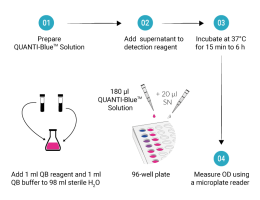
• SEAP is a secreted form of human embryonic alkaline phosphatase. It is extremely heat stable and resistant to the inhibitor L-homoarginine. It catalyzes the hydrolysis of pNitrophenyl phosphate (pNpp) producing a yellow end product. SEAP levels can be evaluated qualitatively with the naked eye and quantitatively using a spectrophotometer at 405 nm in combination with SEAP detection media, such as HEK-Blue™ Detection or QUANTI-Blue™ Solution, a SEAP detection reagent.
• Lucia is a secreted coelenterazine luciferase encoded by a synthetic gene developed by InvivoGen. It generates 1000-fold higher bioluminescent signal compared to the commonly used Firefly and Renilla luciferases. Lucia luciferase activity can be evaluated using QUANTI-Luc™ 4 Lucia/Gaussia, an assay reagent containing all the components required to quantitively measure the activity of Lucia luciferase and other coelenterazine-utilizing luciferases.
• The firefly luciferase (Fluc) gene encodes for an intracellular luciferase of fireflies and click beetles. This enzyme interacts with D-luciferin as a chemiluminescent substrate to produce light emission peaking at 560 nm. After cell lysis, the reaction can be measured and detected simply, rapidly, and with good sensitivity by means of a luminescence-measuring instrument.
• The Renilla luciferase (Rluc) gene encodes for an intracellular luciferase from the sea pansy renilla reniformis. This enzyme catalyzes coelenterazine oxidation leading to bioluminescence and the production of light emission peaking at 480 nm. After cell lysis, the activity can be evaluated using QUANTI-Luc™ 4 Renilla, an assay reagent containing all the components required to quantitively measure the activity of Renilla luciferase and other coelenterazine-utilizing luciferases.
DOCUMENTS
Documents
Technical Data Sheet
Plasmid Sequence
Safety Data Sheet
Plasmid Map and Sequence
Certificate of analysis
Need a CoA ?

 Powered by Bioz