


HEK-Blue™ GIP Cells
-
Cat.code:
hkb-gip
- Documents
ABOUT
GIP-responsive CREB-SEAP reporter assay
HEK-Blue™ GIP Cells are designed to monitor GIP receptor agonist-induced CREB activation through SEAP detection. These engineered cells express the human glucose-dependent insulinotropic polypeptide receptor (GIPR) and a CRE-binding protein (CREB)-inducible SEAP reporter gene. They enable monitoring of GIPR activation through SEAP reporter activity, offering a reliable colorimetric incretin bioassay. This cell line can be used for screening GIP receptor agonists, hormones, and other activator molecules.
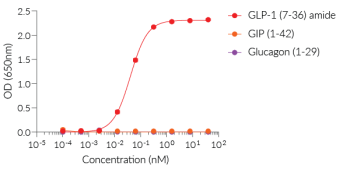
HEK-Blue™ GIP cells strongly respond to the incretin GIP, but not to other G protein-coupled receptor (GPCR)-activating peptide hormones, such as GLP-1 (Glucagon-like peptide-1) or glucagon. The surface expression level of GIPR in HEK-Blue ™ GIP cells is consistent with physiological GIPR density reported in the literature.
The reliable and consistent performance of HEK-Blue™ GIP cells makes them a great tool to measure the potency and activity of metabolic regulators. These cells strongly respond to the well-known hormone receptor drug agonists Tirzepatide and Retatrutide (see figures).
Key features
- Sensitive and easy-to-use colorimetric SEAP bioassay
- Convenient readout using QUANTI-Blue™ Solution
- Strong response to GIPR agonists
- Suitable for kinetic studies (no cell lysis required)
- Stability guaranteed for 20 passages
Applications
- Therapeutic development
- Drug screening
- Release assay
The glucose-dependent insulinotropic polypeptide (GIP), also known as gastric inhibitory polypeptide, is an incretin hormone secreted by enteroendocrine K-cells of the small intestine in response to rising glucose concentrations. It acts through the GIP receptor (GIPR), a G protein-coupled receptor predominantly expressed in pancreatic β-cells and adipocytes. GIPR has emerged as key therapeutic targets in obesity and diabetes research, inspiring the development of dual and triple receptor agonists that synergistically enhance glycemic control, promote weight loss, and improve overall metabolic health.

Illustration on this page were created with BioRender.com.
Disclaimer: These cells are for internal research use only and are covered by a Limited Use License (See Terms and Conditions). Additional rights may be available.

SPECIFICATIONS
Specifications
GIP
Detection and quantification of GIP activity
0.8 nM - 0.00256 nM (GIP (1-42))
1 nM – 0.01 nM (Retatrutide)
1 nM - 0.1 (Tirzepatide)
Complete DMEM (see TDS)
Verified using Plasmotest™
Each lot is functionally tested and validated.
CONTENTS
Contents
-
Product:HEK-Blue™ GIP Cells
-
Cat code:hkb-gip
-
Quantity:3-7 x 10^6 cells
- 1 ml of Blasticidin (10 mg/ml)
- 1 ml of Zeocin® (100 mg/ml)
- 1 ml of Normocin® (50 mg/ml)
- 1 ml of QB reagent and 1 ml of QB buffer (sufficient to prepare 100 ml of QUANTI-Blue™ Solution, a SEAP detection reagent)
Shipping & Storage
- Shipping method: Dry ice
- Liquid nitrogen vapor
- Upon receipt, store immediately in liquid nitrogen vapor. Do not store cell vials at -80°C.
Storage:
Caution:
Details
Cell line description
HEK-Blue™ GIP cells were generated by stable transfection of the human embryonic kidney HEK293 cell line with the gene encoding human GIP receptor (GIPR). In addition, a SEAP (secreted embryonic alkaline phosphatase) reporter gene under the control of a minimal promoter fused to nine cAMP response elements (CRE) was introduced. Binding of GIP or a synthetic hormone receptor agonist to the GIPR on the surface of HEK-Blue™ GIP cells triggers a signaling cascade leading to the activation of the CRE-binding Protein (CREB) pathway and the subsequent production of SEAP. This can be readily assessed in the supernatant using QUANTI‑Blue™ Solution, a SEAP detection reagent.
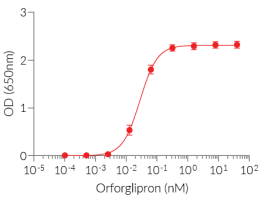
HEK‑Blue™ GIP cells respond to GIP and other GIP receptor (GIPR) agonists, such as Tirzepatide and Retatrutide. They do not respond to other G protein-coupled receptor (GPCR)-activating hormones or their analogs, including GLP-1 (glucagon-like peptide-1), glucagon, Semaglutide, or Orforglipron. HEK-Blue™ GIP cells express approximately 8,000 GIP receptors per cell, a surface receptor density consistent with physiological levels reported in the literature [1].
GIP background

The glucose-dependent insulinotropic polypeptide (GIP), also known as gastric inhibitory polypeptide, is an incretin hormone secreted by enteroendocrine K-cells of the small intestine in response to food intake. It acts via the GIP receptor (GIPR), a G protein-coupled receptor (GPCR) predominantly expressed in pancreatic β cells, adipose tissue, and the central nervous system [2].
Activation of GIPR triggers the activation of the G protein, which stimulates Adenylyl cyclase. This leads to an increase in intracellular cyclic adenosine monophosphate (cAMP) levels. Elevated cAMP activates Protein kinase A (PKA), which then translocates to the nucleus and phosphorylates cAMP response element binding protein (CREB). As a key transcription factor, CREB mediates many of the downstream effects of GIP, including the regulation of glucose homeostasis as well as the survival and proliferation of pancreatic β cells [3].
Upon binding to GIPR, GIP enhances glucose-dependent insulin secretion [2]. Beyond this primary effect, GIP exerts a range of pleiotropic actions, including the promotion of β cell survival and proliferation, the regulation of body weight through centrally mediated appetite suppression, and the attenuation of both peripheral and central inflammation. Emerging evidence also highlights its beneficial roles in cognitive function and bone metabolism. Consequently, alterations in GIP secretion and/or signaling are now recognized as key contributors to the pathogenesis of metabolic disorders such as diabetes and obesity [3].
The discovery of the synergistic action between GIP and GLP-1 has shed new light on the central role of GIP in metabolic regulation. Together, these hormones enhance insulin secretion more effectively than either alone, while also promoting satiety and supporting weight loss. This combined effect has sparked significant interest in therapeutic innovation, leading to the development of novel multi-agonist long-acting compounds such as Tirzepatide (Mounjaro®/Zepbound®) and Retatrutide (LY3437943) [4]. These ligands are now at the forefront of a new generation of treatments, offering transformative potential in the management of diabetes and obesity and are now being explored for other metabolic disorders, including non-alcoholic steatohepatitis (NASH) and non-alcoholic fatty liver disease (NAFLD) [4].
1. Maletti M et al, 1984. Characterization of specific receptors for gastric inhibitory polypeptide (GIP) in a hamster pancreatic beta-cell line. Endocrinology. 114(6), 2344-2350.
2. Drucker DJ, Holst JJ, 2023. The expanding incretin universe: from basic biology to clinical translation. Diabetologia. 66(10):1765-1779.
3. Müller TD et al, 2025 Glucose-dependent insulinotropic polypeptide (GIP). Mol Metab. 95:102118.
4. Gutgesell RM, et al. 2024. Dual and Triple Incretin-Based Co-agonists: Novel Therapeutics for Obesity and Diabetes. Diabetes Ther. 2024 May;15(5):1069-1084.
DOCUMENTS
Documents
Technical Data Sheet
Validation Data Sheet
Safety Data Sheet
Certificate of analysis
Need a CoA ?


 Powered by Bioz