


GIP (1-42)
-
Cat.code:
hlc-gip
- Documents
ABOUT
Selective GIPR agonist – CAS #100040-31-1
GIP (glucose-dependent insulinotropic polypeptide) is an insulinotropic incretin that regulates glucose and lipid homeostasis, making it highly relevant for diabetes research. This gut-derived hormone, formerly known as gastric inhibitory peptide, enhances glucose-dependent insulin secretion, modulates glucagon secretion, and plays an important role in lipid metabolism and energy storage in adipose tissue. As such, the GIP pathway has become a major therapeutic target in diabetes, obesity, and cardiometabolic research.

GIP (1-42) is a 42-amino-acid peptide derived from proGIP, whose sequence is identical in humans and rhesus monkeys. This full-length peptide corresponds to the major biologically active circulating form of GIP and exerts its effects through activation of the GIP receptor (GIPR).
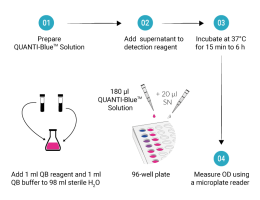
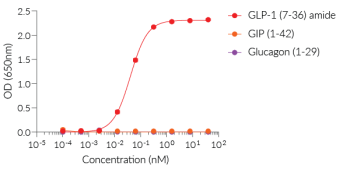
InvivoGen GIP (1-42) is highly pure and guaranteed sterile, making it suitable for in vivo studies. The biological activity is validated using a colorimetric bioassay consisting of the engineered cell line HEK-Blue™ GIP expressing the GIPR together with a CREB-inducible SEAP reporter gene (see figure). Note that the choice of the resuspension buffer, water or physiological water (NaCl 0.9%), has a slight impact on GIP (1-42) biological activity in vitro.
Key features
- Each lot is validated using HEK-Blue™ GIP cells
- Guaranteed sterile
- No ultrasonication step needed
- Endotoxin-tested
Illustrations on this page were created with BioRender.com.
All products are for research use only, and not for human or veterinary use.

SPECIFICATIONS
Specifications
1 mM (4.98 mg/ml) in water or physiological water
0.22 µm filtration, Sterility guaranteed
The absence of bacterial contamination (e.g. lipoproteins and endotoxins) has been confirmed using HEK-Blue™ TLR2 and HEK‑Blue™ TLR4 cells.
Cellular assays (tested)
In vivo assays
Each lot is functionally tested and validated.
Chemical formula: C226H338N60O66 . CF3COOH
Short sequence: YAEGTFISDYSIAMDKIRQQDFVNWLLAQKGKKSDWKHNITQ
Salt form: Trifluoroacetate (TFA)
CONTENTS
Contents
-
Product:GIP (1-42)
-
Cat code:hlc-gip
-
Quantity:1 mg
1.5 ml sterile endotoxin-free physiological water (NaCl 0.9%)
Shipping & Storage
- Shipping method: Room temperature
- -20°C
- -80°C
- Avoid repeated freeze-thaw cycles
Storage:
Caution:
Details
GIPR signaling and metabolic regulation
Glucose-dependent insulinotropic polypeptide (GIP) is a key component of the incretin system and exerts complex metabolic effects through activation of the GIP receptor (GIPR) [1]. In pancreatic islets, GIP enhances glucose-stimulated insulin secretion from β cells primarily via activation of cyclic adenosine monophosphate (cAMP)–dependent signaling, leading to protein kinase A (PKA) and cAMP response element–binding protein (CREB) activation, thereby contributing to postprandial glucose control. In parallel, GIP can also stimulate glucagon secretion from α cells, particularly under normoglycemic or hypoglycemic conditions. The concurrent modulation of two hormones with opposing metabolic actions contributes to the context-dependent physiological effects of GIP signaling [1].
Therapeutic relevance of GIP
Beyond glucose regulation, GIP–GIPR signaling influences lipid metabolism and energy balance in a manner that depends on the prevailing metabolic and hormonal environment. Under conditions of elevated insulin levels, GIP promotes lipid uptake and triglyceride storage in adipose tissue. Conversely, when insulin levels are low, GIP signaling has been associated with stimulation of lipolysis, highlighting its dual role in energy storage and mobilization [1]. GIP exerts modest effects on appetite regulation through actions in the central nervous system compared with glucagon-like peptide-1 receptor (GLP-1), but these effects are markedly enhanced when GIPR signaling is combined with GLP-1 receptor agonism [1, 2].
Owing to this multifaceted biology, the GIP/GIPR axis is widely studied in metabolic research, particularly in association with the GLP-1 and glucagon signaling pathways. These studies have contributed to the development of incretin-based analogues for the treatment of type 2 diabetes and obesity, including dual- and multi-receptor agonists aimed at improving glycemic control and body weight management [1–3].
1. Müller TD et al., 2025. Glucose-dependent insulinotropic polypeptide (GIP). Molecular Metabolism. 95:102118.
2. Zheng Z et al., 2024. Glucagon-like peptide-1 receptor: mechanisms and advances in therapy. Signal Transduct Target Ther. 9:234.
3. Gutgesell R et al., 2024. Dual and Triple Incretin-Based Co-agonists: Novel Therapeutics for Obesity and Diabetes
DOCUMENTS
Documents
Technical Data Sheet
Validation Data Sheet
Safety Data Sheet
Certificate of analysis
Need a CoA ?

 Powered by Bioz