


Retatrutide
-
Cat.code:
hlc-reta
- Documents
ABOUT
GLP-1R / GIPR / GCGR poly-agonist – CAS #2381089-83-2
Retatrutide (LY3437943) is a triple agonist of the GIP, GLP-1, and glucagon receptors that has reshaped obesity and diabetes research. GLP-1 (glucagon-like peptide-1) and GIP (glucose-dependent insulinotropic polypeptide) are incretin hormones that regulate glucose homeostasis by stimulating glucose-dependent insulin secretion, slowing gastric emptying, and reducing appetite, while glucagon signaling promotes energy expenditure. Retatrutide is currently under clinical investigation for the treatment of obesity, type 2 diabetes, and other metabolic disorders.

Retatrutide is a synthetic 39-amino-acid peptide engineered from the native GIP sequence and modified to enable simultaneous activation of the GIP receptor (GIPR), GLP-1 receptor (GLP-1R), and glucagon receptor (GCGR). Structural modifications confer increased resistance to enzymatic degradation and extend its half-life to 150–180 hours, supporting once-weekly administration.
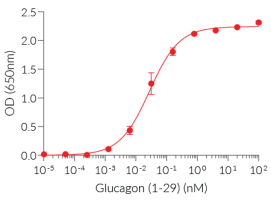
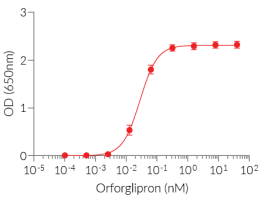
InvivoGen Retatrutide is highly pure and guaranteed sterile, making it suitable for in vivo studies. The biological activity can be assessed using colorimetric bioassays consisting of engineered cell lines HEK-Blue™ GLP-1, HEK-Blue™ GIP, and HEK-Blue™ Glucagon expressing the GLP-1R, GIPR, or GCGR, respectively, together with a CREB-inducible SEAP reporter gene (see figure).
Key features
- Each lot is validated using proprietary incretin bioassay
- Guaranteed sterile
- No ultrasonication step needed
- Endotoxin-tested
Illustrations on this page were created with BioRender.com.
All products are for research use only, and not for human or veterinary use.

SPECIFICATIONS
Specifications
1 mM (4.73 mg/ml) in water or physiological water
0.22 µm filtration, Sterility guaranteed
The absence of bacterial contamination (e.g. lipoproteins and endotoxins) has been confirmed using HEK-Blue™ TLR2 and HEK‑Blue™ TLR4 cells.
Cellular assays (tested)
In vivo assays
Each lot is functionally tested and validated.
Chemical formula: C221H342N46O68 . Na
Short sequence: Y-{Aib}-QGTFTSDYSI-{α-Me-Leu}-LDK-{Lys(AEEA-γGlu-C20 diacid)}AQ-{Aib}-AFIEYLLEGGPSSGAPPPS
Salt form: Sodium salt
CONTENTS
Contents
-
Product:Retatrutide
-
Cat code:hlc-reta
-
Quantity:5 mg
1.5 ml sterile endotoxin-free physiological water (NaCl 0.9%)
Shipping & Storage
- -20°C
- -80°C
- Avoid repeated freeze-thaw cycles
Storage:
Caution:
Details
GLP-1R/GIPR/GCGR signaling and metabolic regulation
Peptide hormones acting through the glucagon-like peptide-1 receptor (GLP-1R), the glucose-dependent insulinotropic polypeptide receptor (GIPR), and the glucagon receptor (GCGR) play complementary roles in the regulation of glucose metabolism and energy balance [1]. In pancreatic β cells, activation of these G protein–coupled receptors primarily signals through pathways involving cyclic adenosine monophosphate (cAMP), protein kinase A (PKA), and cAMP response element–binding protein (CREB), thereby enhancing glucose-dependent insulin secretion and supporting β-cell function.
Beyond their insulinotropic effects, coordinated GLP-1R, GIPR, and GCGR signaling also influence lipid metabolism and energy expenditure by modulating hepatic lipid handling and adipose tissue function. Dysregulation of these pathways contributes to impaired insulin secretion, altered lipid homeostasis, hyperglycemia, and metabolic dysfunction observed in obesity and type 2 diabetes [1].
Therapeutic relevance of Retatrutide
Exploitation of GLP-1R, GIPR, and GCGR signaling has driven the development of multi-receptor–targeted therapeutic strategies. Retatrutide (LY3437943) represents a major advance in this direction as a synthetic peptide designed to simultaneously activate GLP-1R, GIPR, and GCGR [2,3]. Retatrutide exhibits a prolonged circulating half-life of approximately 150–180 hours, enabling sustained multi-receptor engagement. Through coordinated activation of incretin and glucagon pathways, retatrutide enhances glucose-dependent insulin secretion, improves glycemic control, promotes lipid utilization and energy expenditure, and reduces appetite and food intake, highlighting its relevance for obesity and type 2 diabetes [2,3].
1. Gutgesell RM et al., 2024. Dual and Triple Incretin-Based Co-agonists: Novel Therapeutics for Obesity and Diabetes. Diabetes Ther.15(5):1069-1084.
2. Kaur K & Misra S, 2024. A review of an investigational drug retatrutide, a novel triple agonist agent for the treatment of obesity. Eur J of Clin Pharm. 8:669-676.
3. Rosenstock J et al., 2023. Retatrutide, a GIP, GLP-1 and glucagon receptor agonist, for people with type 2 diabetes: a randomised, double-blind, placebo and active-controlled, parallel-group, phase 2 trial conducted in the USA. Lancet. 402:529-44.
DOCUMENTS
Documents
Technical Data Sheet
Validation Data Sheet
Safety Data Sheet
Certificate of analysis
Need a CoA ?

 Powered by Bioz