
Recombinant human IL-34
-
Cat.code:
rcyc-hil34NEW
- Documents
ABOUT
Human IL-34 protein - Mammalian cell-expressed, tag-free, carrier-free
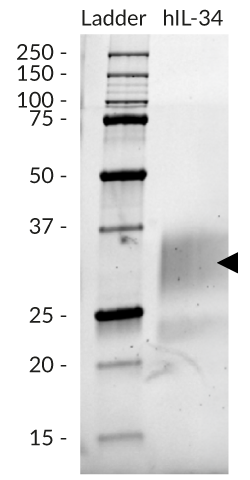
Recombinant human IL-34 is a high-quality and biologically active cytokine, validated using proprietary IL-34 reporter cells. This Type I cytokine receptor family member is produced in CHO cells to ensure protein glycosylation and bona fide 3D structure.
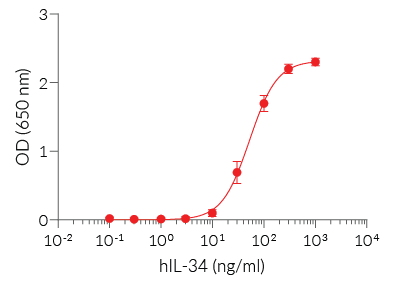
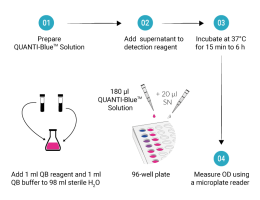
Recombinant human IL-34 can be used together with HEK-Blue™ IL-34/M-CSF cells for the screening of inhibitory molecules, such as monoclonal antibodies targeting IL-34 or its receptor (see figures).
Key features
- Each lot is validated using HEK-Blue™ IL-34/M-CSF cells
- Endotoxin ≤ 0.1 EU/µg
- 0.22 µm sterile-filtered
Applications
- Standard for IL-34 detection and quantification assays
- Screening and release assays for antibodies blocking IL-34 signaling
- Screening and release assays for engineered IL-34
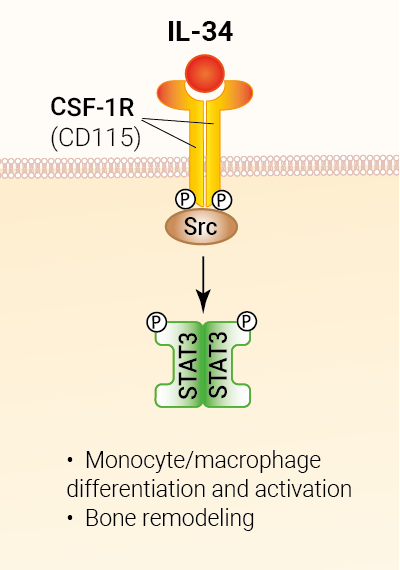
Interleukin-34 (IL-34) is a cytokine that regulates the survival, differentiation, and function of monocytes and macrophages through binding to the colony-stimulating factor-1 receptor (CSF-1R/CD115).

Disclaimer: These cells are for internal research use only and are covered by a Limited Use License (See Terms and Conditions). Additional rights may be available.
Meet the MiniKines™: Collectible Cytokine Cards
SPECIFICATIONS
Specifications
Q6ZMJ4
100 μg/ml in water
Phosphate buffer saline (pH 7.4), 5% saccharose
0.22 µm filtration
The absence of bacterial contamination (e.g. lipoproteins and endotoxins) has been confirmed using HEK-Blue™ TLR2 and HEK‑Blue™ TLR4 cells.
Cellular assays (tested), ELISA
Each lot is functionally tested and validated.
CONTENTS
Contents
-
Product:Recombinant human IL-34
-
Cat code:rcyc-hil34
-
Quantity:10 µg
1.5 ml endotoxin-free water
Shipping & Storage
- Shipping method: Room temperature
- -20°C
- Avoid repeated freeze-thaw cycles
Storage:
Caution:
Details
Interleukin-34 (IL-34) is a cytokine that regulates the survival, differentiation, and function of monocytes and macrophages through binding to the colony-stimulating factor-1 receptor (CSF-1R/CD115). Similar to macrophage colony-stimulating factor (M-CSF, CSF-1), IL-34 activates multiple signaling pathways downstream of CSF-1R, including JAK/STAT3, ERK1/2, PI3K/AKT, NF-κB, and Src-family kinases, thereby regulating cell proliferation, survival, migration, and activation [1,2].
IL-34 plays an important role in tissue homeostasis by maintaining tissue-resident macrophages, particularly microglia in the central nervous system and Langerhans cells in the skin. Owing to its restricted tissue distribution, IL-34 contributes to the specialization of local immune responses and can promote macrophage polarization toward either inflammatory or immunoregulatory phenotypes depending on the microenvironment [1,2].
Aberrant IL-34 expression has been associated with chronic inflammation, autoimmune diseases, fibrosis, and cancer, including rheumatoid arthritis, inflammatory bowel disease, lupus nephritis, liver fibrosis, and multiple malignancies. In the tumor microenvironment, IL-34 promotes the accumulation of immunosuppressive tumor-associated macrophages, fostering immune evasion, tumor progression, and therapeutic resistance. Consequently, the IL-34/CSF-1R signaling axis has emerged as an attractive target for the development of novel anti-inflammatory and anti-cancer therapies [2–4].
References:
1. Lelios I et al., 2020. Emerging roles of IL-34 in health and disease. J Exp Med. 217(3) e20190290.
2. Muñoz-Garcia J et al., 2021. The twin cytokines interleukin-34 and CSF-1: masterful conductors of macrophage homeostasis. Theranostics. 11(4) 1568–1593.
3. Monteleone I, et al., 2022. Targeting IL-34/MCSF-1R Axis in Colon Cancer. Front Immunol.13: 917955.
4. Igarashi Y, Seino K., 2025. Role of IL-34 in Tumors and Its Application to Regulate Inflammation, Cancer Sci, 116:1164–1170.
DOCUMENTS
Documents
Technical Data Sheet
Validation Data Sheet
Safety Data Sheet
Certificate of analysis
Need a CoA ?

 Powered by Bioz