
Recombinant human M-CSF
-
Cat.code:
rcyc-hmcsfNEW
- Documents
ABOUT
Human M-CSF protein - Mammalian cell-expressed, tag-free, carrier-free
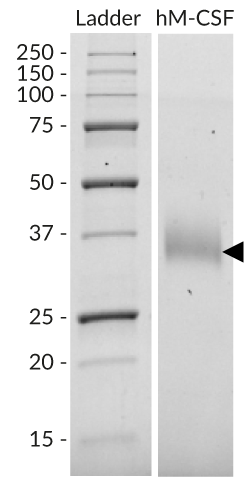
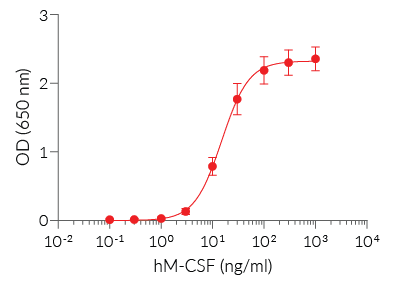
Recombinant human M-CSF is a high-quality and biologically active cytokine, validated using proprietary M-CSF reporter cells. This Type I cytokine receptor family member is produced in CHO cells to ensure protein glycosylation and bona fide 3D structure.
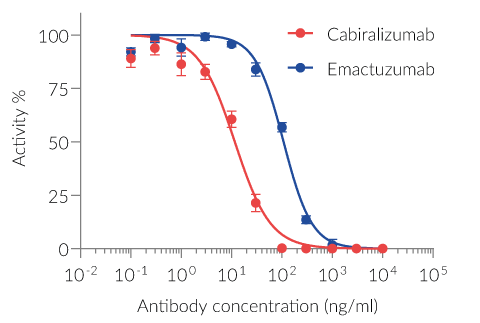
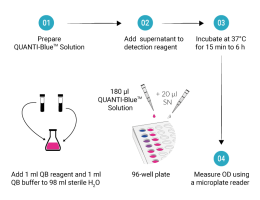
Recombinant human M-CSF can be used together with HEK-Blue™ IL-34/M-CSF cells for the screening of inhibitory molecules such as monoclonal antibodies targeting hM-CSF or its receptor (see figures).
Key features
- Each lot is validated using HEK-Blue™ IL-34/M-CSF cells
- Endotoxin ≤ 1 EU/mg
- 0.22 µm sterile-filtered
Applications
- Standard for M-CSF detection and quantification assays
- Screening and release assays for antibodies blocking M-CSF signaling
- Screening and release assays for engineered M-CSF
Macrophage Colony-Stimulating Factor (M-CSF, also known as CSF-1) is a key regulator of monocyte and macrophage development, survival, and function.

Disclaimer: These cells are for internal research use only and are covered by a Limited Use License (See Terms and Conditions). Additional rights may be available.
Meet the MiniKines™: Collectible Cytokine Cards
SPECIFICATIONS
Specifications
P09603
100 μg/ml in water
Glycine phosphate buffer (pH 7), stabilizing agents, 5% saccharose
0.22 µm filtration
The absence of bacterial contamination (e.g. lipoproteins and endotoxins) has been confirmed using HEK-Blue™ TLR2 and HEK‑Blue™ TLR4 cells.
Cellular assays (tested), ELISA
Each lot is functionally tested and validated.
CONTENTS
Contents
-
Product:Recombinant human M-CSF
-
Cat code:rcyc-hmcsf
-
Quantity:10 µg
1.5 ml endotoxin-free water
Shipping & Storage
- Shipping method: Room temperature
- -20°C
- Avoid repeated freeze-thaw cycles
Storage:
Caution:
Details
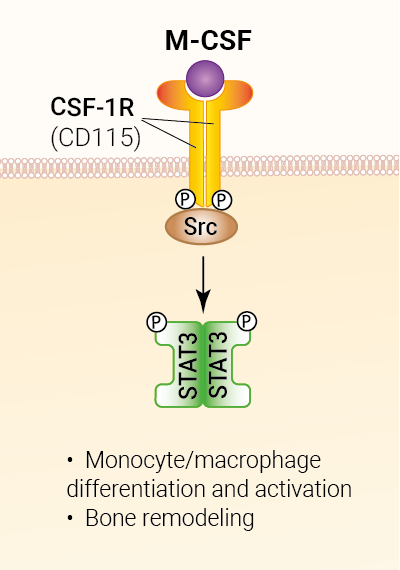
Macrophage colony-stimulating factor (M-CSF, also known as CSF-1) is a key regulator of monocyte and macrophage biology [1–3]. M-CSF signals through the colony-stimulating factor-1 receptor (CSF-1R/CD115), a receptor also activated by interleukin-34 (IL-34). Unlike IL-34, which displays a more restricted tissue distribution, M-CSF is constitutively expressed in multiple tissues, where it maintains monocyte and macrophage homeostasis under physiological conditions [1–3].
Upon binding to CSF-1R, M-CSF induces receptor dimerization and activates downstream signaling pathways including JAK/STAT3, ERK1/2, PI3K/AKT, NF-κB, and Src-family kinases [2,3]. These pathways regulate macrophage proliferation, differentiation, migration, phagocytic activity, and polarization, and are frequently associated with tissue repair and M2-like phenotypes [1,2].
Dysregulation of the M-CSF/CSF-1R axis has been implicated in chronic inflammation, autoimmune diseases, atherosclerosis, fibrosis, and cancer [1,3–5]. Elevated M-CSF levels promote macrophage recruitment and accumulation at sites of chronic inflammation and within the tumor microenvironment. Sustained activation of CSF-1R signaling further contributes to fibrosis and the establishment of immunosuppressive macrophage populations. Consequently, the M-CSF/CSF-1R pathway has emerged as an attractive therapeutic target in inflammatory disorders and oncology [4,5].
References:
1. Trus E et al., 2020. Who's in charge here? Macrophage colony stimulating factor and granulocyte macrophage colony stimulating factor: Competing factors in macrophage polarization. Cytokine. 127:154939.
2. Ushach I, Zlotnik A, 2016. Biological role of granulocyte macrophage colony-stimulating factor (GM-CSF) and macrophage colony-stimulating factor (M-CSF) on cells of the myeloid lineage. J Leukoc Biol. 100:481–489.
3. Muñoz-Garcia J et al., 2021. The twin cytokines interleukin-34 and CSF-1: masterful conductors of macrophage homeostasis. Theranostics. 11(4):1568–1593.
4. Sinha SK et al., 2021. Local M-CSF (Macrophage Colony-Stimulating Factor) Expression Regulates Macrophage Proliferation and Apoptosis in Atherosclerosis. Arterioscler Thromb Vasc Biol. 41:220–233.
5. He K et al., 2022. G-CSF/GM-CSF-induced hematopoietic dysregulation in the progression of solid tumors. FEBS Open Bio. 12:1268–1285.
DOCUMENTS
Documents
Technical Data Sheet
Validation Data Sheet
Safety Data Sheet
Certificate of analysis
Need a CoA ?

 Powered by Bioz