

Recombinant human G-CSF
-
Cat.code:
rcyec-hgcsf
- Documents
ABOUT
Human G-CSF protein - E. coli-expressed, tag-free, carrier-free
Recombinant human G-CSF is a high-quality and biologically active cytokine, validated using proprietary G-CSF reporter cells. This Type I cytokine receptor family member is produced in E. coli and thoroughly purified to remove endotoxins.
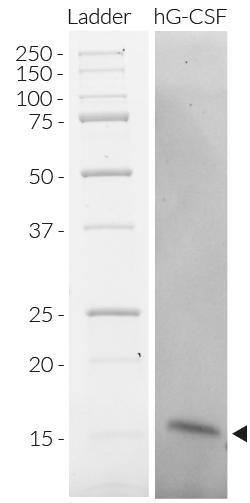
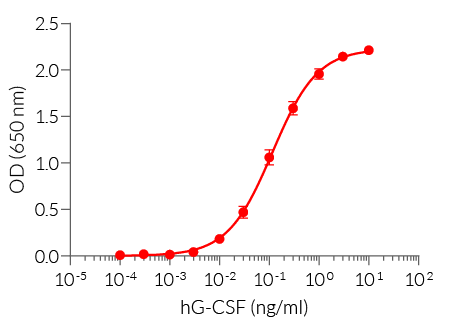
Recombinant human G-CSF can be used together with HEK-Blue™ G-CSF cells for the screening of inhibitory molecules, such as therapeutic monoclonal antibodies blocking G-CSF signaling (see figures).
Key features
- Each lot is validated using HEK-Blue™ G-CSF cells
- Endotoxin < 0.01 EU/µg
- 0.22 µm sterile-filtered
Applications
- Standard for G-CSF detection and quantification assays
- Screening and release assays for antibodies blocking G-CSF signaling
- Screening and release assays for engineered G-CSF
G-CSF, also known as colony-stimulating factor 3 (CSF3), is a secreted cytokine and hematopoietic growth factor. It regulates the differentiation, proliferation, and function of neutrophils. While G-CSF contributes to host defense against pathogens, it can also have detrimental effects by promoting inflammatory diseases and cancer.

All products are for research use only, and not for human or veterinary use.
Meet the MiniKines™: Collectible Cytokine Cards

Get free Minikines™ cards
with your order of recombinant cytokines.
Learn more about MiniKines™ Cards
SPECIFICATIONS
Specifications
P09919-2
100 μg/ml in water
HAc-NaAc, 150 mM NaCl, 0.004 % Tween 80.5 % Mannitol, pH 4.0
The absence of bacterial contamination (e.g. lipoproteins and endotoxins) has been confirmed using HEK-Blue™ TLR2 and HEK‑Blue™ TLR4 cells.
Cellular assays
Each lot is functionally tested and validated.
CONTENTS
Contents
-
Product:Recombinant human G-CSF
-
Cat code:rcyec-hgcsf
-
Quantity:10 µg
Shipping & Storage
- Shipping method: Room temperature
- -20 °C
- Avoid repeated freeze-thaw cycles
Storage:
Caution:
Details
The granulocyte colony-stimulating factor (G-CSF) is a secreted cytokine and hematopoietic growth factor that belongs to the Type I/II cytokine receptor family. G-CSF regulates the differentiation, proliferation, and function of neutrophils [1]. It exerts its biological functions through the formation of a tetramer consisting of two G-CSF molecules and the homodimeric G-CSF receptor (GCSFR, aka CD114). The binding of G-CSF to its receptor triggers activation of the JAK/STAT signaling pathway [1,2]. STAT1, STAT3, and STAT5 are involved in this activation step and the induction of cellular proliferation [1,2].
Due to its well-known function in the maturation and mobilization of neutrophils from the bone marrow, it is widely used as an adjuvant treatment in severe cases of chemotherapy-induced neutropenia during hematopoietic stem cell transplantation in multiple myeloma treatment [3-4]. Studies in humans and mice also indicate that while G-CSF contributes to host defense against pathogens, it can also have detrimental effects by promoting inflammatory diseases and cancer [1,2,4]. A plethora of studies have shown that G-CSF-secreting tumors are highly aggressive and directly linked with secondary metastasis, worse prognosis, and low survival rates [4]. However, other studies have suggested that within the G-CSF-secreting tumor, the dynamic changes caused in the tumor microenvironment can be used as markers of early disease progression and therapeutic response [4].
References:
1. Martin KR., et al., 2021. G-CSF — A double-edged sword in neutrophil-mediated immunity. Sem Immunol. 54:101516.
2. Park, DS., et al., 2022. A review of granulocyte colony-stimulating factor receptor signaling and regulation with implications for cancer. Front Oncol. DOI: 10.3389/fonc.2022.932608.
3. Crees ZD, et al., 2023. Motixafortide and G-CSF to mobilize hematopoietic stem cells for autologous transplantation in multiple myeloma: a randomized phase 3 trial. Nat Med. 29(4):869-879.
4. Karagiannidis I, et al. 2021. G-CSF in tumors: Aggressiveness, tumor microenvironment and immune cell regulation. Cytokine. 142:155479.
DOCUMENTS
Documents
Technical Data Sheet
Validation Data Sheet
Safety Data Sheet
Certificate of analysis
Need a CoA ?


 Powered by Bioz