

Anti-hIL-25-mIgG2a
-
Cat.code:
mab10-hil25
- Documents
ABOUT
Recombinant anti-human IL-25 (IL-17E) neutralizing monoclonal antibody
Anti-hIL-25-mIgG2a is a monoclonal antibody (mAb) targeting human interleukin 25 (hIL-25).
This recombinant mAb is an InvivoGen proprietary clone (16D4) and is produced in Chinese hamster ovary (CHO) cells, ensuring reliability and lot-to-lot reproducibility. This antibody has been selected for its ability to efficiently neutralize the biological activity of hIL-25.
Interleukin-25 (also known as IL-17E) is a member of the IL-17 family (IL-17A – 17F). IL-25 is mainly produced by epithelial cells and promotes the expression of type 2 cytokines in barrier tissues (e.g., skin, lungs, gastrointestinal tract). Dysregulated IL-25 expression has been associated with multiple inflammatory disorders such as atopic dermatitis, psoriasis, or asthma.

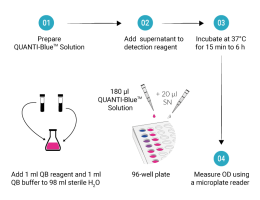
This antibody can be used together with HEK-Blue™ IL-25/IL-17C cells treated with recombinant human IL-25 for screening and neutralization assays to block IL-25 signaling.
Key features
- Each lot is functionally tested and validated.
- The complete sequence of the antibody construct has been verified.
- The absence of endotoxins is determined by the EndotoxDetect™ assay.
All InvivoGen products are for internal research use only, and not for human or veterinary use.

SPECIFICATIONS
Specifications
IL-25 (IL-17E)
Human
Sodium phosphate buffer with glycine, saccharose, and stabilizing agents
0.22 µm filtration
Negative (tested using EndotoxDetect™ assay)
Neutralization assay
Each lot is functionally tested and validated.
CONTENTS
Contents
-
Product:Anti-hIL-25-mIgG2a
-
Cat code:mab10-hil25
-
Quantity:100 µg
Shipping & Storage
- Shipping method: Room temperature
- -20°C
- Avoid repeated freeze-thaw cycles
Storage:
Caution:
Details
IL-25 background
Interleukin 17 (IL-17) is a family of six closely related cytokines (IL-17A to IL-17F) that exhibit both pro- and anti-inflammatory activity. IL-25 (also known as IL-17E) is primarily described as a "barrier surface" cytokine. It is produced by various cell types, including T helper 2 (Th2) cells, mast cells, or epithelial cells, and it acts on both immune and tissue-resident cells in barrier tissues (e.g., skin, lungs, gastrointestinal tract) [1, 2].
IL-25 binds a homodimeric transmembrane receptor that comprises the IL-17RA subunit shared by all IL-17 isoform receptors and the IL-17RB subunit. The binding of IL-25 to its receptor triggers the recruitment of ACT1 (activator of NF-κB1), which recruits and ubiquitinates TRAF6 (TNF receptor-associated factor 6). The subsequent signaling cascade leads to the activation of the canonical NF-κB and AP-1 pathways [1, 2]. While all IL-17 family members promote inflammatory neutrophilic responses, IL-25 induces the expression of type 2 cytokines (i.e., IL-4, IL-5, IL-13, and TSLP). This functional divergence led to the renaming of IL-17E as IL-25 [2].
Relevance for therapeutics development
Dysregulated IL-25 expression has been associated with multiple inflammatory disorders.
- In the skin, IL-25 contributes to epidermal homeostasis under steady state conditions [1]. However, elevated IL-25 expression is found in the lesions of skin disorders, such as atopic dermatitis, psoriasis, and contact dermatitis [1].
- In the gut, IL-25 expression by chemosensory cells is upregulated upon parasite infection. IL-25 then contributes to recruiting Th2 cells and ILC2 (type 2 innate lymphoid cells) to mediate anti-helminth immunity [1]. IL-25 has been reported to play both pathogenic and protective functions in different inflammatory bowel disease (IBD) settings, which is characterized by an imbalance of the Th1/Th2 cytokine response. Although extensive data have been generated in experimental colitis models, the precise role of IL-25 in ulcerative colitis patients remains incompletely defined [1].
- In the airways, IL-25 expression by chemosensory cells is induced in response to infections and allergens. While IL-25 may contribute to epithelial protection, sustained type-2 immune activation has been implicated in the pathogenesis of chronic rhinosinusitis and asthma [1].
Given its central role in type-2 immunity, therapeutic blockade of IL-25 signaling represents a promising strategy to alleviate Th2-driven inflammatory diseases. SM17, a humanized monoclonal antibody targeting the IL-17RB subunit of the IL-25 receptor, has completed a phase I clinical trial (NCT05332834), demonstrating a favorable safety, tolerability, and pharmacokinetic profile. Further clinical development is ongoing for the treatment of atopic dermatitis. In preclinical mouse models, administration of IL-25-blocking antibodies has been shown to ameliorate Th2-mediated airway inflammation [1].
References:
1. Borowczyk, J., et al., 2021. IL-25 (IL-17E) in epithelial immunology and pathophysiology. Journal of Allergy and Clinical Immunology. 148(1):40-52.
2. McGeachy, M.J. et al., 2019. The IL-17 Family of Cytokines in Health and Disease. Immunity. 50(4):892-906.
DOCUMENTS
Documents
Technical Data Sheet
Validation Data Sheet
No ressource available.
Certificate of analysis
Need a CoA ?


 Powered by Bioz