
Recombinant mouse IL-13 (CHO)
-
Cat.code:
rcyc-mil13NEW
- Documents
ABOUT
Recombinant mouse IL-13 protein - Mammalian cell-expressed, tag-free, carrier-free
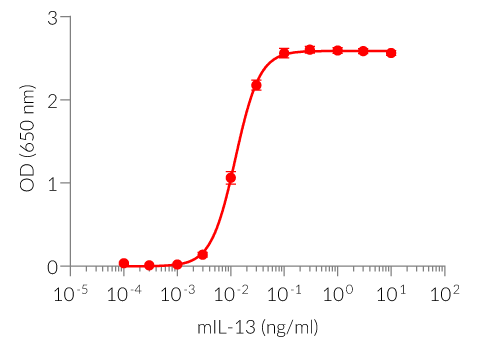
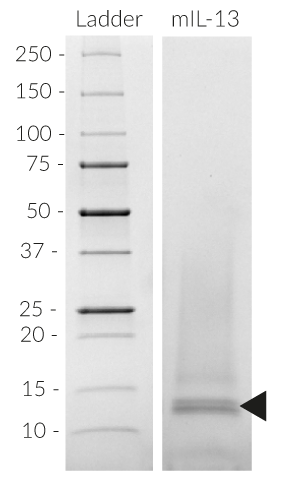
Recombinant mouse IL-13 is a high-quality and biologically active cytokine, validated using proprietary mIL-4/IL-13 reporter cells. This member of the IL-2/γc superfamily is produced in CHO cells to ensure protein glycosylation and bona fide 3D structure.
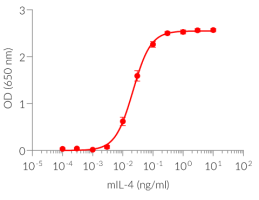
Recombinant human IL-13 can be used together with HEK-Blue™ mIL-4/IL-13 cells for the screening of inhibitory molecules, such as Anti-mIL-13-mIgG1, or antibodies targeting its receptors and cross-reacting with their human counterparts (see figures).
Key features
- Each lot is validated using HEK-Blue™ mIL-4/IL-13 cells
- Endotoxin ≤ 0.001 EU/µg
- 0.22 µm sterile-filtered
Applications
- Standard for mIL-13 detection and quantification
- Screening and release assays for antibodies blocking mIL-13 signaling
- Screening and release assays for engineered mIL-13
Interleukin 13 (IL-13) shares a common receptor subunit, IL-4Rα, with IL-4. These two cytokines play an important role in anti-parasitic immune responses. Dysregulated IL-4 /IL-13 expression contributes to Th2-mediated diseases, including asthma and atopic dermatitis.

Disclaimer: These cells are for internal research use only and are covered by a Limited Use License (See Terms and Conditions). Additional rights may be available.

Meet the MiniKines™: Collectible Cytokine Cards

Get free Minikines™ cards
with your order of recombinant cytokines.
Learn more about MiniKines™ Cards
SPECIFICATIONS
Specifications
P20109
100 μg/ml in water
Glycine phosphate buffer (pH 7) containing stabilizing agents and 5% saccharose
0.22 µm filtration
The absence of bacterial contamination (e.g. lipoproteins and endotoxins) has been confirmed using HEK-Blue™ TLR2 and HEK‑Blue™ TLR4 cells.
Cellular assays (tested), ELISA
Each lot is released only after meeting predefined biological activity specifications in a cell-based assay.
CONTENTS
Contents
-
Product:Recombinant mouse IL-13 (CHO)
-
Cat code:rcyc-mil13
-
Quantity:10 µg
1.5 ml endotoxin-free water
Shipping & Storage
- Shipping method: Room temperature
- -20°C
- Avoid repeated freeze-thaw cycles
Storage:
Caution:
Details
Interleukin 13 background
IL-13 is a cytokine that belongs to the IL-2/γc superfamily. IL-13 is produced as a secreted monomeric molecule by activated CD4+ T cells, Natural Killer T cells (NKT cells), group 2 innate lymphoid cells (ILC2s), macrophages, mast cells, basophils, or eosinophils [1].
IL-13 binds a heterodimeric receptor composed of the IL-4Rα and IL-13Rα1 chains. This receptor is shared with IL-4, which can bind two different receptors: Type I (IL-4Rα and common γ chain) and Type II (IL-4Rα and IL-13Rα1). The binding of IL-13 to its receptor triggers a signaling cascade leading to the activation of STAT6. Subsequent gene expression drives M2 macrophage polarization, B-cell proliferation, IgE immunoglobulin class switching, and eosinophil activation and survival [1]. In non-hematopoietic cells, IL-13 is essential for mucus production, goblet cell hyperplasia, and worm expulsion [1]. Altogether, the downstream IL-13 effector functions participate in parasitic infection clearance and allergic reactions [1].
Relevance for therapeutics development
IL-13 is a key cytokine for controlling infections by extracellular parasites. However, along with IL-4, it also contributes to harmful allergic responses [1, 2]. As the prevalence of chronic allergic diseases such as asthma and atopic dermatitis is increasing worldwide, there has been a keen interest in the therapeutic blocking of IL-4 and IL-13 signaling.
Dupilumab is a fully human monoclonal antibody (mAb) that targets the IL-4Rα subunit [3]. It acts like a receptor antagonist and inhibits the signaling of both IL-4 and IL-13 [3]. Dupilimab was FDA-approved in 2017 for treating asthma, atopic dermatitis, and chronic sinusitis [3, 4]. Due to its favorable safety profile and established clinical use, Dupilumab holds significant promise for amending treatment options for many dermatologic conditions [5].
Tralokinumab and Lebrikizumab are fully human mAbs that target IL-13, inhibiting its receptor binding ability. Tralokinumab and Lebrikizumab were FDA-approved in 2021 and 2024, respectively, for treating moderate-to-severe atopic dermatitis [6, 7]
References:
1. Bernstein, Z.J., et al., 2023. Engineering the IL-4/IL-13 axis for targeted immune modulation. Immunol Rev. 320(1):29-57.
2. Ogulur, I., et al., 2025. Type 2 immunity in allergic diseases. Cell & Mol Immunol, 22(3):211-242.
3. Harb, H. & Chatila, T.A., 2020. Mechanisms of Dupilumab. Clin Exp Allergy. 50(1):5-14.
4. https://www.accessdata.fda.gov/drugsatfda_docs/label/2022/761055s040lbl.pdf
5. Olbrich, H., et al., 2023. Dupilumab in Inflammatory Skin Diseases: A Systematic Review. Biomolecules.13(4):634.
6. https://www.accessdata.fda.gov/drugsatfda_docs/nda/2022/761180Orig1s000lbl.pdf
7. https://www.accessdata.fda.gov/drugsatfda_docs/label/2024/761306Orig1s000correctedlbl.pdf
DOCUMENTS
Documents
Technical Data Sheet
Validation Data Sheet
Safety Data Sheet
Certificate of analysis
Need a CoA ?


 Powered by Bioz