



HEK-Blue™IL-2Rα/β/γ Cells
-
With a free vial of human IL-2 protein
-
Cat.code:
hkb-hil2rabgv2-2NEW
- Documents
ABOUT
IL-2/IL-15 STAT5-SEAP reporter assay in a high-CD25 receptor background
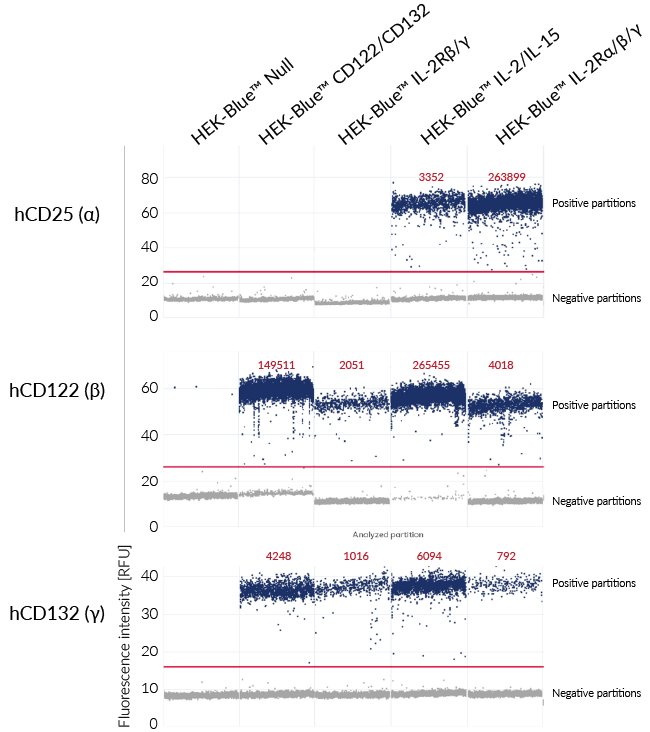
HEK-Blue™ IL-2Rα/β/γ cells are designed for the screening of CD25 (IL-2Rα)-neutralizing molecules, such as the anti-hIL-2Rα antibody Daclizumab. These reporter cells can also be used to monitor IL-2 and IL-15-induced STAT5 activation in a receptor background characterized by high CD25 and low CD122 (IL-2R<β)/CD132 (IL-2Rγ) expression.
HEK-Blue™ IL-2Rα/β/γ cells respond strongly to recombinant human (h) IL-2. They also respond to recombinant hIL-15 and, to a lesser extent, mouse (m) IL-2, while showing no response to mIL-15 (see figures). Compared to HEK-Blue™ IL-2/IL-15 cells, their high CD25 and low CD122/CD132 expression profile makes them particularly suitable for CD25-targeted neutralization assays, high-affinity IL-2 biologic screening, and comparative IL-2/IL-15 signaling studies in a high-CD25 receptor environment.
Key features
- Readily assessable STAT5-SEAP reporter activity
- Convenient readout using QUANTI-Blue™ Solution
- Detection of human (h) IL-2 and IL-15 within high-CD25 receptor background
- Suitable for CD25-targeted neutralization assays
- Stability guaranteed for 20 passages
InvivoGen offers four IL-2 and IL-15 reporter cell lines, HEK-Blue™ IL-2Rα/β/γ, HEK-Blue™ IL-2/IL-15, HEK-Blue™ IL-2Rβ/γ, and HEK-Blue™ CD122/CD132, with distinct receptor expression profiles and cytokine detection potencies (see table below). Digital PCR was used to confirm the expression profiles of these three IL-2 receptor subunits in the HEK-Blue™ reporter cell lines (see image carousel above).
| Reporter cell line | Receptor expression | Cytokine detection potency | |||||
|---|---|---|---|---|---|---|---|
hCD25 (α) | hCD122 (β) | hCD132 (γ) | hIL-2 | hIL-15 | mIL-2 | mIL-15 | |
| HEK-Blue™ IL-2Rα/β/γ | High | Low | Low | ++++ | +++ | ++ | - |
| HEK-Blue™ IL-2/IL-15 Cells | Low | High | High | +++ | ++++ | ++ | - |
| HEK-Blue™ IL-2Rβ/γ | None | Low | Low | + | ++ | - | - |
| HEK-Blue™ CD122/CD132 | None | High | High | ++++ | ++++ | +/- | +/- |
IL-2 and IL-15 are closely related cytokines that belong to the IL-2 family and display important functions in the immune system . They share the heterodimeric CD122/CD132 receptor to deliver their signals within target cells. Their specificity of action is conferred by their α receptor chains, CD25 and CD215 (IL-15Rα).

Disclaimer: These cells are for internal research use only and are covered by a Limited Use License (See Terms and Conditions). Additional rights may be available.

SPECIFICATIONS
Specifications
IL-2
IL-15
Human
Mouse
0.01 - 1 ng/ml (hIL-2)
0.01 - 10 ng/ml (mIL-2)
0.03 - 3 ng/ml (hIL-15)
Complete DMEM (see TDS)
Verified using Plasmotest™
Each lot is functionally tested and validated.
CONTENTS
Contents
-
Product:HEK-Blue™IL-2Rα/β/γ Cells
-
Cat code:hkb-hil2rabgv2-2
-
Quantity:3-7 x 10^6 cells
- 1 ml Puromycin (10 mg/ml)
- 2 x 1 ml of HEK-Blue™ Selection (250x concentrate)
- 1 ml Normocin® (50 mg/ml)
- 1 ml of QB reagent and 1 ml of QB buffer (sufficient to prepare 100 ml of QUANTI-Blue™ Solution, a SEAP detection reagent).
Shipping & Storage
- Shipping method: Dry ice
- Liquid nitrogen vapor
- Upon receipt, store immediately in liquid nitrogen vapor. Do not store cell vials at -80°C.
Storage:
Caution:
Details
Cell line description
HEK-Blue™ IL-2Rα/β/γ cells were generated by stable transfection of the human embryonic kidney HEK293 cell line with the genes encoding for the human CD25 (IL-2Rα), CD122 (IL-2Rβ), and CD132 (IL-2Rγ) subunits. These cells were engineered to express high levels of CD25 together with low levels of CD122 and CD132, enabling preferential detection of high-affinity IL-2 signaling. They also feature stable expression of human JAK3 and STAT5 to obtain a fully functional IL-2/IL-15 signaling pathway, as well as a STAT5-inducible secreted embryonic alkaline phosphatase (SEAP) reporter. The binding of IL-2 or IL-15 to their receptors triggers a signaling cascade leading to the activation of STAT5 and the subsequent production of SEAP. This can be readily assessed in the supernatant using QUANTI-Blue™ Solution, a SEAP detection reagent.
HEK-Blue™ IL-2Rα/β/γ cells strongly respond to human IL-2 and display lower responsiveness to IL-15, consistent with their high CD25 and low CD122/CD132 expression profile. Owing to their elevated CD25 expression, HEK-Blue™ IL-2Rα/β/γ cells are particularly suitable for evaluating CD25-targeted therapeutics, high-affinity IL-2 biologics, and CD25-dependent IL-2 signaling. They can also be used to assess IL-15 bioactivity and compare IL-2- and IL-15-induced STAT5 signaling in a high-CD25 receptor environment. In addition, these cells can be used to validate the functionality, potency, toxicity, and dose-dependent effects of IL-2- and IL-15-based biologics.
IL-2 and IL-15 background
Interleukin-2 (IL-2) and interleukin-15 (IL-15) are closely related cytokines that play central roles in the regulation of innate and adaptive immune responses [1,2]. Both cytokines signal through receptor complexes containing the CD122 and CD132 subunits, while their biological specificity is conferred by distinct α receptor chains: CD25 (IL-2Rα) for IL-2 and CD215 (IL-15Rα) for IL-15 [1,3]. The incorporation of CD25 into the receptor complex generates the highest-affinity IL-2 receptor. This enables cells expressing elevated CD25 levels to respond efficiently to low concentrations of IL-2 [3,4].
The binding of IL-15 and IL-2 to their heterodimeric or heterotrimeric receptors activates JAK1/JAK3-STAT5 signaling together with the PI3K/AKT/mTOR and MAPK pathways, resulting in cellular responses such as proliferation, survival, differentiation, and immune effector functions [1,3]. IL-2 is a key regulator of activated T cells and regulatory T cells (Tregs), whereas IL-15 plays an important role in the development, maintenance, and activation of natural killer (NK) cells and memory CD8+ T cells [1,2].
Aberrant IL-2 and IL-15 signaling has been associated with T-cell large granular lymphocytic leukemia, cutaneous T-cell lymphoma, adult T-cell leukemia/lymphoma, multiple myeloma, celiac disease, rheumatoid arthritis, psoriasis, and inflammatory bowel disease, while CD25 overexpression has been reported in several hematological malignancies and solid tumors [1-4]. Consequently, IL-2-, IL-15-, and CD25-directed therapies are being actively developed for the treatment of cancer, autoimmune disorders, and chronic inflammatory diseases [1-4].
1. Sindaco P, et al., 2023. The role of interleukin-15 in the development and treatment of hematological malignancies. Front Immunol. 14:1141208
2. Propper DJ & Balkwill FR, 2022. Harnessing cytokines and chemokines for cancer therapy. Nat. Rev. Clin. Oncol. 19:237-253.
3. Peng Y, et al., 2022. CD25: A potential tumor therapeutic target. Int J Cancer. 151:1617-1626.
4. Al Nasar M, et al., 2024. The T-Cell Growth Factor Interleukin-2, Which Is Occasionally Targeted by Autoantibodies, Qualifies as Drug for the Treatment of Allergy, Autoimmunity, and Cancer: Collegium Internationale Allergologicum (CIA) Update 2024. Int Arch Allergy Immunol. 185:286-300.
DOCUMENTS
Documents
Technical Data Sheet
Validation Data Sheet
Safety Data Sheet
Certificate of analysis
Need a CoA ?



 Powered by Bioz