


STG-1151 VacciGrade™
-
Cat.code:
vac-stg1151
- Documents
ABOUT
DBCO STING agonist for click-chemistry bioconjugation - VacciGrade™
STG-1151 is a DBCO-functionalized STING agonist designed for site-specific, click-chemistry conjugation to an azido-functionalized protein of interest (POI), especially in pre-clinical or translational settings.
This conjugatable PRR ligand is derived from the proprietary cyclic dinucleotide CL845 to support the development of targeted immunotherapeutic bioconjugates, including immunostimulatory ADCs (antibody-drug conjugates, also known as ISACs) and AACs (antigen-adjuvant conjugates).

Recommended use
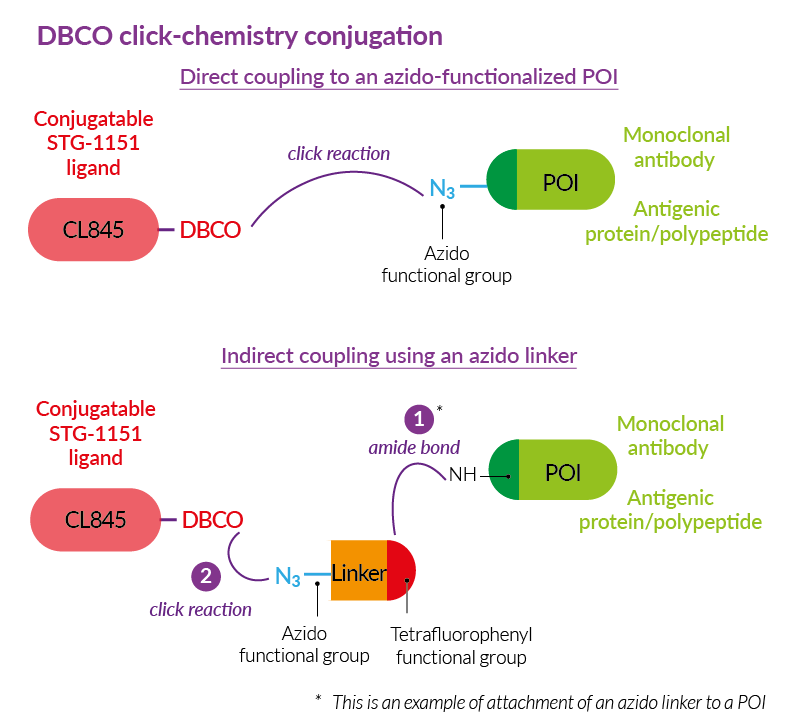
STG-1151 is best suited for applications requiring controlled agonist loading and preservation of POI structure in reproducible and translational settings. The conjugation can be performed directly with azide-modified POIs [1] or indirectly with commercially available azido linkers (see figure).
The site-specific conjugation strategy is designed to overcome major limitations for clinical translation, including disruption of protein folding and epitope exposure, off-target toxicity associated with high agonist dose, heterogeneous conjugation ratios, and batch-to-batch variability.
For applications requiring greater flexibility in linker selection, see STG-968 (Azido).
For rapid proof-of-concept studies using direct conjugation, see STG-982 (Maleimide).
 Learn more about bioconjugation
Vaccination and adjuvantation performance
STG-1151-based AACs promote strong Th1-polarized immune responses (in-house data, see figures). Moreover, biopharmas have successfully induced strong cellular and humoral immunity using STG-1151-based AACs in vaccination models [2].
Key features
- Potent STING agonist
- DBCO functionalization for controlled click-conjugation
- Compatible with azide-modified proteins or linkers
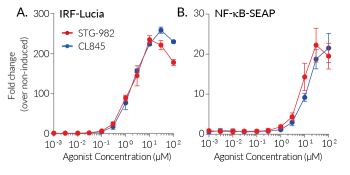
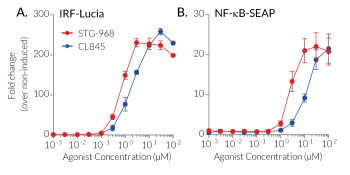
- Biological activity confirmed using cellular assays
- STING activation validated following protein conjugation
- VacciGrade™: a high-quality pre-clinical grade
Applications
- ADC / ISAC-driven immunomodulation
- AAC-mediated vaccination
1. Weiss, A.M., et al., 2021. Site-specific antigen-adjuvant conjugation using cell-free protein synthesis enhances antigen presentation and CD8+ T-cell response. Sci Rep 11, 6267.
2. Bettin, L., et al., 2026. A Chlamydia trachomatis CPAF-STING agonist conjugate vaccine administered intramuscularly and intradermally is immunogenic in the pig model. Front Immunol. 17:1816737.
All InvivoGen products are for internal research use only, and not for human or veterinary use.

VacciGrade™
VacciGrade™ is a high-quality pre-clinical grade, suitable for in vivo studies. VacciGrade™ products are filter-sterilized (0.2 µm) and filled under strict aseptic conditions in a clean room. The absence of bacterial contamination is assessed by a sterility test using a pharmacopeia-derived assay.
SPECIFICATIONS
Specifications
STING
C65H76F2N14O19P2S • Na
10 mg/ml (6.6 mM) in DMSO
Sterility guaranteed
< 5 EU/mg (measurement by kinetic chromogenic LAL assay)
Antigen-adjuvant conjugation (tested)
Antibody-drug conjugation
Each lot is functionally tested and validated.
CONTENTS
Contents
-
Product:STG-1151 VacciGrade™
-
Cat code:vac-stg1151
-
Quantity:250 µg
Shipping & Storage
- Shipping method: Room temperature
- -20°C
- Avoid repeated freeze-thaw cycles
Storage:
Caution:
Details
STING as a therapeutic target
Given its critical implication in NF-κB- and IRF-mediated production of type I IFNs (IFN-α/β) and pro-inflammatory cytokines in response to cytosolic DNA, STING has been a major target for the development of immunomodulatory therapeutics [1, 2]. InvivoGen offers conjugatable STING agonists in multiple functional formats to support diverse bioconjugation strategies. STG-1151 and other derivatives STG-982 and STG-968 are based on the same proprietary STING agonist, CL845, and differ by their reactive functional handle, enabling DBCO, maleimide-, or azido-based coupling, respectively.
STG-1151 DBCO functional handle for click-chemistry
STG-1151 features a DBCO functional group that has been coupled to CL845’s phosphorothioate group via a “built-in” linker. It allows conjugation directly with azide-modified proteins of interest (POIs) or indirectly with an azido linker.
STG-1151 bioconjugation using an azido linker occurs in two steps:
– Step 1: Azido linker attachment to solvent-accessible cysteine or lysine residues on the POI
– Step 2: Click reaction between the DBCO group of STG-1151 and the complementary linker azido functional group
Common features of conjugatable STING ligands
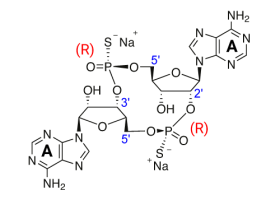
InvivoGen STG-1151 was engineered from CL845 (cAIM(PS) Difluor (Rp)), an analog of the clinical STING agonist CL656 (cAIM(PS)2 Difluor (Rp/Sp)) [2-6]. STING signaling is triggered upon ligand binding to a small pocket that cannot accommodate large molecules [1]. Therefore, once the bioconjugate has entered the target cell, CL845 must dissociate from the rest of the molecule. To secure this step, STING conjugatable ligands were designed with a “cleavable linker”, composed of:
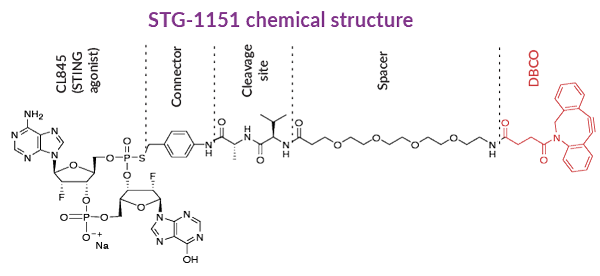
- a spacer: polyethylene glycol (PEG) to improve flexibility and reduce steric hindrance [7, 8],
- a cleavage site: Val-Ala dipeptide, a substrate of the lysosomal protease cathepsin B [8],
- a connector: para-aminobenzoic (PAB) moiety that supports protease accessibility and self-immolative release of CL845 [8].
Applications for conjugatable STING ligands
Conjugatable STING agonists are designed for the development of targeted, immunotherapeutic bioconjugates. Their controlled conjugation to antibodies or antigenic proteins enables localized activation of the STING pathway, enhancing innate and adaptive immune responses in cancer and vaccination models.
- Antibody-drug conjugates (ADCs / ISACs)
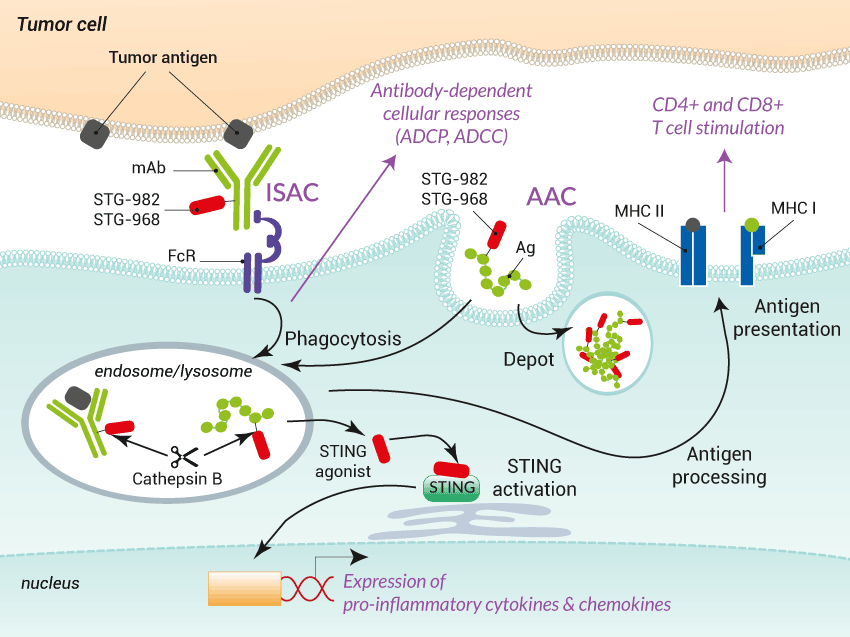
STING agonist conjugation to monoclonal antibodies (mAbs) generates immunostimulatory ADCs. Such constructs are promising cancer immunotherapeutic strategies due to their complementary mechanisms of action [9, 10] (see illustration):
– Antibody-mediated tumor cell killing upon recognition of specific tumor antigen by the mAb variable region.
– mAb binding to Fcγ receptor (FcγR)-expressing cells, such as antigen-presenting cells (APCs). The engagement of FcγR may induce antibody-dependent cellular cytotoxicity (ADCC), antibody-dependent cellular phagocytosis (ADCP), or complement-dependent cytotoxicity (CDC).
– STING activation in the tumor target cells (not shown) or neighboring myeloid cells after ADC internalization. This results in the production of type I interferons and pro-inflammatory cytokines.
- Antigen-adjuvant conjugates (AACs)
Conjugation of STING agonists to antigenic peptides/proteins generates AACs for vaccination and immune priming. These AACs enable (see illustration):
– Co-delivery of antigen and STING agonist to APCs
– Antigen processing and STING activation in the same APC
The conjugation strategy helps overcome the dissociation of the antigen and STING agonist upon mixture administration and allows a prolonged antigen presentation for the induction of adaptive immune responses, probably through an intracellular storage/depot effect [11, 12].
References:
1. Zhang H., et al. 2020. Targeting Stimulator of Interferon Genes (STING): a medicinal chemistry perspective. Journal of Medicinal Chemistry. 63(8):3785.
2. Jang S., et al. 2021. ExoSTING, an extracellular vesicle loaded with STING agonists, promotes tumor immune surveillance. Commun. Biol. 4:497.
3. Pro-cyclic dinucleotides and pro-cyclic dinucleotide conjugates for cytokine induction. WO 2019/129880A1 and foreign equivalents.
4. Cyclic dinucleotides for cytokine induction, patent US10011630B2 and foreign equivalents.
5. Lioux T., et al. 2016. Design, synthesis, and biological evaluation of novel cyclic adenosine-inosine monophosphate (cAIMP) analogs that activate stimulator of interferon genes (STING). J. Med. Chem. 59:10253.
6. https://clinicaltrials.gov/ct2/show/NCT04592484
7. Drago J.Z, et al. 2021. Unlocking the potential of antibody-drug conjugates for cancer therapy. Nat Rev Clin Oncol. 18(6):327.
8. Poreba M., 2020. Protease-activated prodrugs strategies: challenges, and future directions. The FEBS Journal. 287(10):1936.
9. Wu TY, et al., 2022. Tumor-targeted delivery of a STING agonist improves cancer immunotherapy. PNAS, 119(49):e2214278119.
10. Cetinbas, MN, et al., 2024. Tumor cell-directed STING agonist antibody-drug conjugates induce type III interferons and anti-tumor innate immune responses. Nat comm., 15(1):5842.
11. Van Montfoort N. et al., 2009. Antigen storage compartments in mature dendritic cells facilitate prolonged cytotoxic T lymphocyte cross-priming capacity. PNAS. 106(16):6730.
12. Ho N.I. et al., 2021. Distinct antigen uptake receptors route to the same storage compartments for cross-presentation in dendritic cells. Immunology. 164(3):494.
DOCUMENTS
Documents
Technical Data Sheet
Validation Data Sheet
Safety Data Sheet
Certificate of analysis
Need a CoA ?

 Powered by Bioz