

Jurkat-Lucia™ NFAT-CD64 Cells
-
Cat.code:
jktl-nfat-cd64
- Documents
ABOUT
FcγRI ADCP Effector Activity Reporter Jurkat Cell Assay
Jurkat-Lucia™ NFAT-CD64 cells were engineered from the human T lymphocyte Jurkat-Lucia™ NFAT cell line to evaluate the potency of biologics that trigger ADCP through CD64, the Fc-gamma receptor I (FcγRI).
Antibody-dependent cell-mediated phagocytosis (ADCP) is one major mode of action (MOA) of therapeutic monoclonal Abs (mAbs). The cytotoxic outcome depends on the differential binding affinities of IgG subclasses for each Fcγ receptor. Fine-tuning ADCP activity is critical for therapeutic success and represents a key strategy in the development and optimization of next-generation biological therapeutics.

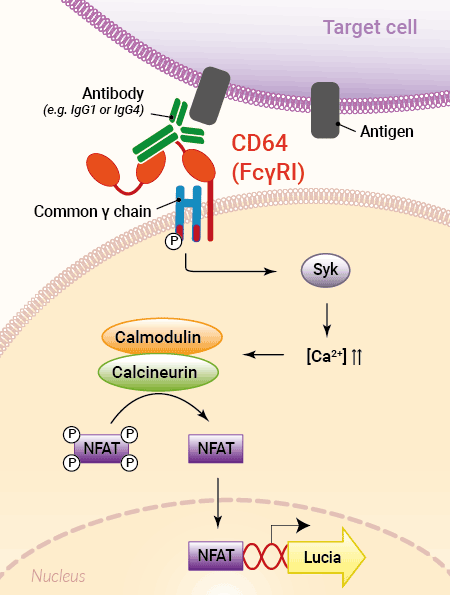
InvivoGen's ADCP effector activity assay consists of engineered Jurkat cells stably expressing the relevant Fcγ receptor variant FcγRI and a Lucia® luciferase gene regulated by the NFAT response element. The induction of ADCP, reflected by the strong NFAT-mediated Lucia® activation, was assessed when Jurkat-Lucia™ NFAT-CD64 effector cells were incubated with Raji target cells and a panel of anti-hCD20 Rituximab antibodies featuring different Fc subclasses (see figures).
Key features
- Readily assessable Lucia® luciferase reporter activity for NFAT activation
- No primary cell culture required
- Robust and reproducible assay design
- Stability guaranteed for 20 passages
Applications
- Screening of potent biologics for ADCP induction
- Evaluation of Fc engineering strategies to modulate ADCP potency
- Testing of novel anti-CD64 mAbs

Disclaimer: These cells are for internal research use only and are covered by a Limited Use License (See Terms and Conditions). Additional rights may be available.
SPECIFICATIONS
Specifications
Induction of antibody-dependent cellular phagocytosis (ADCP)
Complete IMDM (see TDS)
Verified using Plasmotest™
Each lot is functionally tested and validated.
Human CD64 expression has been verified by flow cytometry.
CONTENTS
Contents
-
Product:Jurkat-Lucia™ NFAT-CD64 Cells
-
Cat code:jktl-nfat-cd64
-
Quantity:3-7 x 10^6 cells
- 1 ml of Blasticidin (10 mg/ml)
- 1 ml of Zeocin® (100 mg/ml)
- 1 ml of Normocin™ (50 mg/ml)
- 1 tube of QUANTI-Luc™ 4 Reagent (sufficient to prepare 25 ml)
Shipping & Storage
- Shipping method: Dry ice
- Liquid nitrogen vapor
- Upon receipt, store immediately in liquid nitrogen vapor. Do not store cell vials at -80°C.
Storage:
Caution:
Details
Cell line description
Jurkat-Lucia™ NFAT-CD64 cells were generated from the human T lymphocyte Jurkat cell line Jurkat-Lucia™ NFAT featuring an NFAT-inducible Lucia® luciferase reporter gene. They stably express the cluster of differentiation 64 (CD64), the high-affinity FcγRI that binds the constant region of immunoglobulin G (IgG) [1]. CD64-mediated NFAT activation is readily assessable in the supernatant using QUANTI-Luc™ 4 Lucia/Gaussia, a detection reagent. Of note, Jurkat cells naturally express a functional NFAT (nuclear factor of activated T cells) transcription factor, which is involved in the early signaling events of ADCC and ADCP [2-3].
ADCC & ADCP
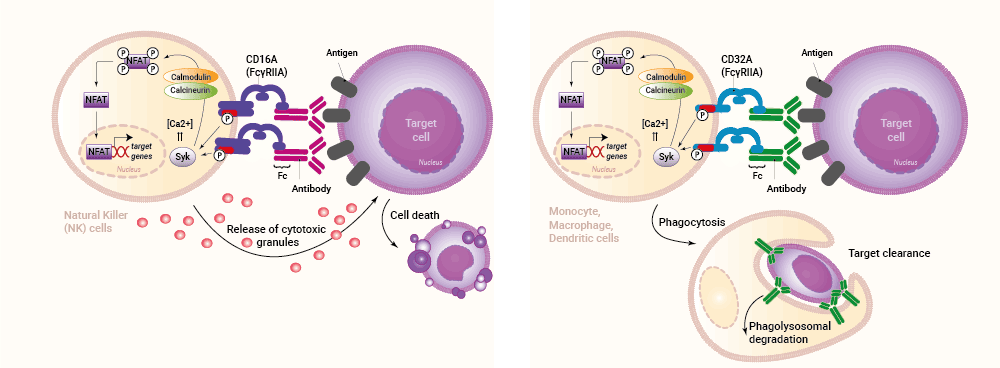
ADCC and ADCP - short for antibody-dependent cellular cytotoxicity & phagocytosis - are immune mechanisms through which Fc receptor-bearing effector cells can recognize and clear antibody (Ab)-coated microbes and target cells expressing specific antigens on their surface. Human IgGs bind to activatory FcγRI (CD64), FcγRIIA (CD32A), FcγRIIa (CD16A), and inhibitory (FcγRIIb) receptors. The IgG-FcγR interaction is regulated by the Ab isotype and glycosylation [4, 5]. FcγRs differ in their cellular distribution and are often co-expressed. High-affinity FcγRI (CD64) is expressed on myeloid cells, including monocytes and macrophages. The low-affinity FcγRIIA (CD32A) is expressed on myeloid cells, including monocytes, macrophages, and dendritic cells (DCs), whereas FcγRIIIa (CD16A) is expressed on macrophages and natural killer (NK) cells [1, 6].
ADCC and ADCP are initiated when multiple IgG molecules bind simultaneously to FcγRs. The binding of antibody-antigen complexes to activatory and inhibitory FcγRs induces their cross-linking and subsequent signaling through immunoreceptor tyrosine-based activation motifs (ITAMs) and inhibition motifs (ITIMs), respectively. Cytoplasmic signaling includes an increase in intracellular calcium concentration and calcineurin/calmodulin-mediated dephosphorylation of NFAT (nuclear factor of activated T cells), allowing its nuclear translocation and binding to promoter regions of ADCC and ADCP relevant genes [4, 5].
References:
1. Nagelkerke S.Q. et al., 2019. Genetic variation in low-to-medium-affinity Fcγ receptors: functional consequences, disease associations, and opportunities for personalized medicine. Front. Immunol. 10:2237.
2. Shaw J-P. et al., 1998. Identification of a putative regulator of early T cell activation genes. Science. 241:202.
3. Leibson P.J., 1997. Signal transduction during natural killer cell activation: inside the mind of a killer. Immunity. 6:655.
4. Quast I. et al., 2016. Regulation of antibody effector functions through IgG Fc N-glycosylation. Cell. Mol. Life. Sci. 74(5):837-47.
5. Tay M.Z. et al., 2019. Antibody-Dependent Cellular Phagocytosis in Antiviral Immune Responses. Front Immunol. 10:332.
6. Holtrop T, et al. 2022. Targeting the high-affinity receptor, FcγRI, in autoimmune disease, neuropathy, and cancer. Immunother Adv.2(1):ltac011.
DOCUMENTS
Documents
Technical Data Sheet
Validation Data Sheet
Safety Data Sheet
Certificate of analysis
Need a CoA ?


 Powered by Bioz