
HCT116-Lucia™ AhR Cells
-
Cat.code:
hctl-ahrNEW
- Documents
ABOUT
Human Aryl Hydrocarbon receptor Lucia® reporter HCT116 colorectal carcinoma cell line
HCT116-Lucia™ AhR cells are a bioluminescent reporter cell line designed for the quantitative study of aryl hydrocarbon receptor (AhR) signaling. These cells express endogenous AhR and an AhR-inducible Lucia® luciferase reporter, enabling sensitive detection of AhR activation. This cell-based AhR reporter assay can be used to screen and characterize AhR agonists and antagonists, including microbiota-, diet-, and tryptophan-derived AhR ligands.

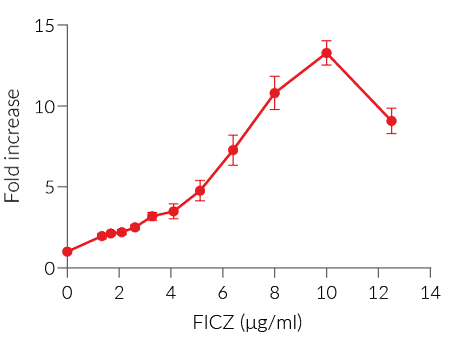
In HCT116-Lucia™ AhR cells, AhR activation upon stimulation with ligands, such as FICZ, is quantified by measuring secreted Lucia® luciferase activity in the cell culture supernatant using QUANTI-Luc™ 4 Lucia/Gaussia, a Lucia® luciferase detection reagent (see figures). At high concentrations, FICZ can exhibit cytotoxicity toward these cells, as verified using InvivoGen's cytotoxicity assay LDH-Blue™ Plus.
Key features
- Readily assessable Lucia® luciferase reporter activity
- Human HCT116 colorectal carcinoma cell background
- Relevant to intestinal and microbiota-derived AhR ligand research
- Stability guaranteed for 20 passages
Applications
- AhR antagonist/inhibitor screening
- Tryptophan metabolite research
- Intestinal AhR signaling
Disclaimer: These cells are for internal research use only and are covered by a Limited Use License (See Terms and Conditions). Additional rights may be available.
SPECIFICATIONS
Specifications
Aryl Hydrocarbon Receptor (AhR)
Human
AhR agonist screening
AhR antagonist screening
AhR compound profiling
Xenobiotic-response research
Complete DMEM (see TDS)
Verified using Plasmotest™
Each lot is functionally tested and validated.
CONTENTS
Contents
-
Product:HCT116-Lucia™ AhR Cells
-
Cat code:hctl-ahr
-
Quantity:3-7 x 10^6 cells
- 1 ml Zeocin® (100 mg/ml)
- 1 ml Normocin™ (50 mg/ml)
- 1 tube of QUANTI-Luc™ 4 Reagent, a Lucia luciferase detection reagent (sufficient to prepare 25 ml)
Shipping & Storage
- Shipping method: Dry ice
- Liquid nitrogen vapor
- Upon receipt, store immediately in liquid nitrogen vapor. Do not store cell vials at -80°C.
Storage:
Caution:
Details
Cell line description
HCT116-Lucia™ AhR cells were generated from the human colorectal carcinoma HCT116 cell line, which endogenously expresses the aryl hydrocarbon receptor (AhR) [1]. Their colorectal origin makes these cells particularly relevant for studying AhR responses to intestinal and microbiota-derived ligands.
HCT116-Lucia™ AhR cells stably express the secreted Lucia® luciferase reporter gene under the control of a minimal promoter coupled to the complete regulatory sequence of the human CYP1A1 gene, containing six dioxin response elements (DREs).
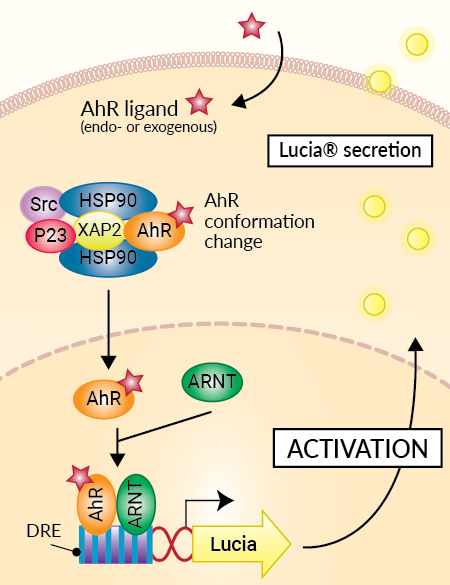
In the absence of a ligand, AhR is retained in the cytoplasm as part of a multiprotein complex. Upon binding of an AhR agonist, such as FICZ, AhR is activated and released from its cytoplasmic complex. Activated AhR then translocates into the nucleus, where it heterodimerizes with the AhR nuclear translocator (ARNT). The AhR/ARNT complex binds to DREs and induces the transcription of AhR-responsive genes. In HCT116-Lucia™ AhR cells, activation of this pathway also drives the expression and secretion of Lucia® luciferase. AhR activation can therefore be readily quantified by measuring Lucia® luciferase activity in the cell culture supernatant using QUANTI-Luc™ 4 Lucia/Gaussia.
AhR Background
The aryl hydrocarbon receptor (AhR) is a ligand-dependent transcriptional factor widely expressed in barrier tissues [2]. AhR plays a key role in gut-microbiota and host immune homeostasis [2]. Besides xenobiotics, including the prototypic AhR agonist 2,3,7,8-tetrachlorodibenzo-p-dioxin (TCDD), a variety of dietary-derived AhR ligands have been identified, many of which are byproducts of tryptophan metabolism [2].
Inactive AhR resides inactive in the cytoplasm within protein complex consisting of Hsp90:XAP2:p23:Src. The AhR canonical genomic signaling pathway occurs as follows: upon ligand binding, the complex undergoes conformational changes and partly translocates into the nucleus. AhR heterodimerizes with AhR nuclear translocator (ARNT) before binding to dioxin response elements (DREs) in the upstream regulatory regions of AhR target genes, such as the cytochrome P450-dependent monooxygenase Cyp1a1 or the AhR repressor (AhRR) [2].
Given the pleiotropic and highly context-dependent nature of AHR signaling, further studies are essential to fully elucidate its complex biological functions and therapeutic potential across a broad range of diseases, including cancer, inflammatory and autoimmune disorders [1-2]. For example, disruptions in AhR signaling have been shown to be involved in the development of diseases such as inflammatory bowel disease (IBD) and atopic dermatitis (AD) [2].
References
1. Karasová M, et al., 2022. Inhibition of Aryl Hydrocarbon Receptor (AhR) Expression Disrupts Cell Proliferation and Alters Energy Metabolism and Fatty Acid Synthesis in Colon Cancer Cells. Cancers (Basel). 14(17):4245
2. Coumoul X, et al., 2026. The aryl hydrocarbon receptor: structure, signaling, physiology and pathology. Signal Transduct Target Ther.11(1):20.
DOCUMENTS
Documents
Technical Data Sheet
Validation Data Sheet
Safety Data Sheet
Certificate of analysis
Need a CoA ?


 Powered by Bioz