

Recombinant human IL-29
-
Cat.code:
rcyc-hil29
- Documents
ABOUT
Human IL-29 protein - Mammalian cell-expressed, tag-free, carrier-free
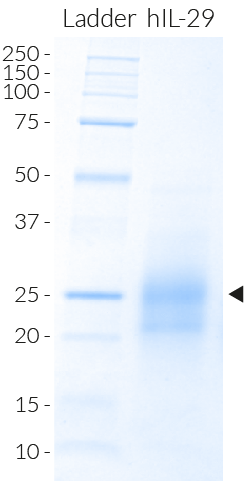
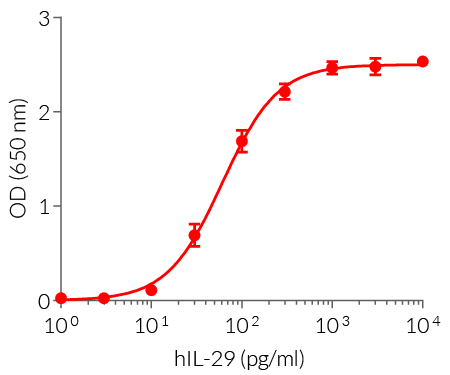
Recombinant human IL-29 is a high-quality and biologically active cytokine, validated using proprietary IFN-λ reporter cells. This member of the type III interferon (IFN) family is produced in CHO cells to ensure protein glycosylation and bona fide 3D structure.
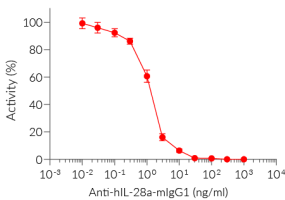
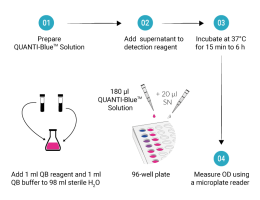
Recombinant human IL-29 can be used together with HEK-Blue™ IFN-λ cells for the screening of inhibitory molecules, such as Anti-hIL-29-mIgG1, a monoclonal antibody targeting IL-29 (see figures).
Key features
- Each lot is validated using HEK-Blue™ IFN-λ cells
- Endotoxin ≤ 0.01 EU/µg
- 0.2 µm sterile-filtered
Applications
- Standard for IL-29 detection and quantification assays
- Screening and release assays for antibodies blocking IL-29 signaling
- Screening and release assays for engineered IL-29
Interleukin-29 (IL-29), also known as interferon lambda 1 (IFN-λ1), belongs to the type III IFNs. Together with IFN-λ2 (IL-28a), IFN-λ3 (IL-28b), and IFN-λ4, it plays a pivotal role in mucosal immunity at epithelial barriers, enhancing antiviral immunity and regulating inflammation.

All products are for research use only, and not for human or veterinary use.
Meet the MiniKines™: Collectible Cytokine Cards
SPECIFICATIONS
Specifications
Q8IU54
100 μg/ml in water
Phosphate buffer saline (pH 7.4), 5% saccharose
0.2 µm filtration
The absence of bacterial contamination (e.g. lipoproteins and endotoxins) has been confirmed using HEK-Blue™ TLR2 and HEK‑Blue™ TLR4 cells.
Cellular assays (tested)
ELISA
Each lot is functionally tested and validated.
CONTENTS
Contents
-
Product:Recombinant human IL-29
-
Cat code:rcyc-hil29
-
Quantity:20 µg
1.5 ml endotoxin-free water
Shipping & Storage
- Shipping method: Room temperature
- -20 °C
- Avoid repeated freeze-thaw cycles
Storage:
Caution:
Details
Interleukin-29 (IL-29), also known as interferon lambda 1 (IFNλ1), is one member of the type III IFN family. Together with IFN-λ2 (IL-28a), IFN-λ3 (IL-28b), and IFN-λ4, it plays a pivotal role in mucosal immunity at epithelial barriers, enhancing antiviral immunity and regulating inflammation1.
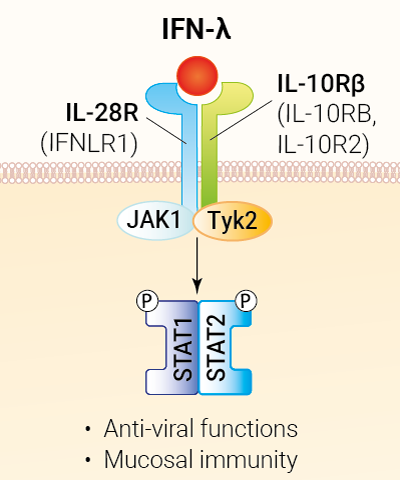
When a viral infection is sensed by pattern recognition receptors, IFN-λs are produced by a variety of cell types, predominantly plasma cell-like dendritic cells (DCs). However, the target cell populations of IFN-λ are tissue-restricted and mainly include epithelial cells, DCs, and T cells2. IL-29 binds to a receptor complex composed of IL-28R1 and IL-10R2. The induced JAK-STAT pathway leads to the activation of STAT1 and STAT2, and subsequently combines with IRF9 to form the ISGF3 transcription factor complex2. Similarly, the activating signaling can also be transmitted to the nucleus via mitogen‐activated protein kinase (MAPK), protein kinase B (Akt), nuclear factor‐kappa B (NF‐κB), and nuclear factor of activated T cell 1 (NFATc1) pathways2.
Besides its antiviral function, IFN-λ signaling also plays an important role in non-infectious diseases like autoimmune diseases and cancer1-2. Increased levels of IL‐29 were detected in the serum of patients with rheumatoid arthritis, psoriasis, as well as systemic sclerosis2. On the other hand, IFN-λ demonstrates broad-spectrum inhibitory activity across cancers, including bladder cancer, melanoma, colorectal carcinoma, and HPV-associated cervical malignancies1. Further research is required to elucidate the dual role of IFN-λ and to gain a deeper understanding of its complex role in immune regulation.
1. Tang B, et al., 2025. IFN-λ: Unleashing Its Potential in Disease Therapies From Acute Inflammation Regulation to Cancer Immunotherapy. Immunology. 176(2):197-214.
2. Wang JM, et al., 2019. Insights into IL-29: Emerging role in inflammatory autoimmune diseases. J Cell Mol Med. 23(12):7926-7932
DOCUMENTS
Documents
Technical Data Sheet
Validation Data Sheet
Safety Data Sheet
Certificate of analysis
Need a CoA ?


 Powered by Bioz