

Recombinant human GM-CSF (CHO)
-
Cat.code:
rcyc-hgmcsf
- Documents
ABOUT
Human GM-CSF protein - Mammalian-expressed, tag-free, carrier-free
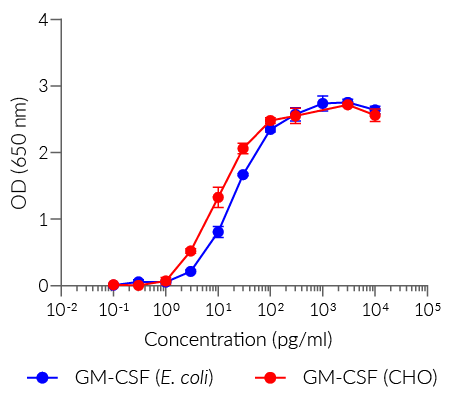
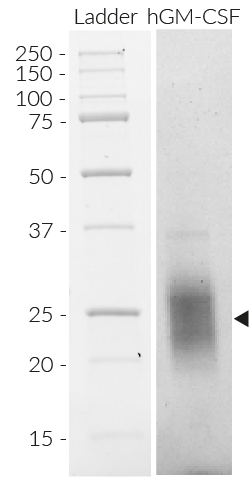
Recombinant human GM-CSF is a high-quality and biologically active cytokine, validated using proprietary GM-CSF reporter cells. This common β chain family member is produced in CHO cells to ensure protein glycosylation and bona fide 3D structure.
Recombinant human GM-CSF can be used together with HEK-Blue™ GM-CSF cells for the screening of inhibitory molecules, such as Mavrilimumab, a therapeutic monoclonal antibody targeting the α subunit of the GM-CSF receptor (GM-CSFR) (see figures).
Key features
- Each lot is validated using HEK-Blue™ GM-CSF cells
- Endotoxin < 0.1 EU/µg
- 0.22 µm sterile-filtered
Applications
- Standard for GM-CSF detection and quantification assays
- Screening and release assays for antibodies blocking GM-CSF signaling
- Screening and release assays for engineered GM-CSF
GM-CSF, also known as colony-stimulating factor 2 (CSF2), belongs to the β-common chain cytokine family. Although originally identified as a hematopoietic growth factor, this cytokine is now regarded as a pleiotropic regulator of inflammation in response to pathogens, autoimmune diseases, and cancer.

All products are for research use only, and not for human or veterinary use.

Meet the MiniKines™: Collectible Cytokine Cards
Get free Minikines™ cards
with your order of recombinant cytokines.
Learn more about MiniKines™ Cards
SPECIFICATIONS
Specifications
P04141
100 μg/ml in water
Phosphate buffer saline (pH 7.4)
The absence of bacterial contamination (e.g. lipoproteins and endotoxins) has been confirmed using HEK-Blue™ TLR2 and HEK‑Blue™ TLR4 cells.
Cellular assays
Cellular assays (tested)
ELISA
Each lot is functionally tested and validated.
CONTENTS
Contents
-
Product:Recombinant human GM-CSF (CHO)
-
Cat code:rcyc-hgmcsf
-
Quantity:20 µg
1.5 ml endotoxin-free water
Shipping & Storage
- Shipping method: Room temperature
- -20°C
- Avoid repeated freeze-thaw cycles
Storage:
Caution:
Details
GM-CSF background
The granulocyte–macrophage colony-stimulating factor (GM-CSF), also known as colony-stimulating factor 2 (CSF2), belongs to the β-common chain cytokine family [1]. It promotes the differentiation, activation, and survival of cells from the myeloid compartment, notably macrophages, dendritic cells, and neutrophils [2, 3]. Although originally identified as a hematopoietic growth factor, this cytokine is now regarded as a pleiotropic regulator of inflammation in response to pathogens, autoimmune diseases, and cancer [2,4].
GM-CSF signalization requires a multimeric structure comprising four α chains (GMRα, aka CD116), four β chains (GMRβ, CD131), and four cytokines. This 12-protein complex allows the juxtaposition of the intracellular Janus kinase 2 (JAK2) and activation of the signal transducer and activator of transcription 5 (STAT5) [1]. Other signaling pathways include ERK, NF-κB, and AKT pathways [1, 5]. The understanding of cellular and molecular mechanisms whereby GM-CSF exerts its varied functions is key for the development of therapeutic strategies (e.g. cancer vaccines, blocking antibodies) [1].
Mavrilimumab is a fully human IgG4 monoclonal antibody that targets the alpha subunit of the granulocyte–macrophage colony-stimulating factor receptor (GM-CSFR), effectively blocking GM-CSF signaling [2]. As of June 2025, Mavrilimumab (CAM-3001) is not yet FDA-approved. It is still under clinical investigation for the treatment of various autoimmune diseases, including rheumatoid arthritis (RA) and giant cell arteritis (GCA) [3, 6].
References:
1. Dougan M. et al., 2019. GM-CSF, IL-3, and IL-5 family of cytokines: regulators of inflammation. Immunity. 50(4):796-811.
2. Burmester GR, et al., 2011. Mavrilimumab, a human monoclonal antibody targeting GM-CSF receptor-α, in subjects with rheumatoid arthritis: a randomised, double-blind, placebo-controlled, phase I, first-in-human study. Ann Rheum Dis. ;70(9):1542-9.
3. Burmester GR, et al. 2017. A randomised phase IIb study of mavrilimumab, a novel GM-CSF receptor alpha monoclonal antibody, in the treatment of rheumatoid arthritis. Ann Rheum Dis. 76(6):1020-1030.
4. Zhan Y. et al., 2019. The Pleiotropic Effects of the GM-CSF Rheostat on Myeloid Cell Differentiation and Function: More Than a Numbers Game. Front Immunol. 102679.
5. Hamilton J.A., 2020. GM-CSF in inflammation. J. Exp . Med. 217(1):e20190945.
6. Cid MC, et al., 2022. Efficacy and safety of mavrilimumab in giant cell arteritis: a phase 2, randomised, double-blind, placebo-controlled trial. Ann Rheum Dis. 2022 May;81(5):653-661.
DOCUMENTS
Documents
Technical Data Sheet
Validation Data Sheet
Safety Data Sheet
Certificate of analysis
Need a CoA ?

 Powered by Bioz