


Recombinant human IL-22
-
Cat.code:
rcyc-hil22
- Documents
ABOUT
Human IL-22 protein - Mammalian cell-expressed, tag-free, carrier-free
Recombinant human IL-22 is a high-quality and biologically active cytokine, validated using proprietary IL-22 reporter cells. This member of the IL-10 cytokine family is produced in CHO cells to ensure protein glycosylation and bona fide 3D structure.
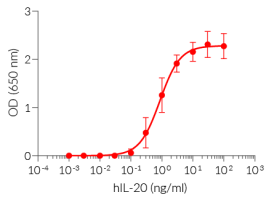
Recombinant human IL-22 can be used together with HEK-Blue™ IL-22 cells for the screening of inhibitory molecules, such as Fezakinumab, a monoclonal antibody that targets IL-22 and prevents its binding to its receptor (see figures).
Key features
- Each lot is validated using HEK-Blue™ IL-22 cells
- Endotoxin ≤ 0.1 EU/µg
- 0.22 µm sterile-filtered
Applications
- Standard for IL-22 detection and quantification
- Screening and release assays for antibodies blocking IL-22 signaling
- Screening and release assays for engineered IL-22
Interleukin 22 (IL-22) is a key regulator of immunity and inflammation at mucosal surfaces, where it helps in maintaining barrier integrity. IL-22 is implicated in several pathologies, including autoimmune diseases and cancer.

All InvivoGen products are for internal research use only, and not for human or veterinary use.

Meet the MiniKines™: Collectible Cytokine Cards
SPECIFICATIONS
Specifications
Q9GZX6
100 μg/ml in water
Phosphate buffer saline (pH 7.0)
0.22 µm filtration
The absence of bacterial contamination (e.g. lipoproteins and endotoxins) has been confirmed using HEK-Blue™ TLR2 and HEK‑Blue™ TLR4 cells.
Cellular assays (tested), ELISA
Each lot is functionally tested and validated.
CONTENTS
Contents
-
Product:Recombinant human IL-22
-
Cat code:rcyc-hil22
-
Quantity:10 µg
1.5 ml endotoxin-free water
Shipping & Storage
- Shipping method: Room temperature
- -20°C
- Avoid repeated freeze-thaw cycles
Storage:
Caution:
Details
Interleukin-22 background
Interleukin 22 (IL-22) is a key regulator of immunity and inflammation at mucosal surfaces, where it helps in maintaining barrier integrity [1-3]. IL-22 production can be triggered by a variety of pathogen-associated molecular patterns (PAMPs). Notably, it can be induced directly by Toll-like receptor 2 (TLR2) activation in response to bacterial-derived agonists, or indirectly via IL-23 in response to aryl-hydrocarbon receptor (AhR) ligands [1, 2]. IL-22 is implicated in a number of pathologies, including autoimmune diseases and cancer [3, 4].
IL-22 exerts its biological effect upon binding to its receptor, which comprises two subunits: IL-22R1 and IL-10Rβ. Upon binding, IL-22 triggers a signaling pathway involving tyrosine kinase 2 (TyK2) and Janus kinase 1 (JAK1), leading to the activation of signal transducer and activator of transcription 3 (STAT3).
1. Wang J.et al., 2018. Aryl hydrocarbon receptor/IL-22/Stat3 signaling pathway is involved in the modulation of intestinal mucosa antimicrobial molecules by commensal microbiota in mice. Innate Immun. 24(5):297-306.
2. Foxall R.B. et al.., 2016. Profile of interleukin-22 in gut mucosal health and disease. IJICMR. 8:1-11.
3. Park J.H. et al., 2017. There Is a Gap in Our Knowledge. Immunohorizons. 2(6):198-207.
4. Hernandez P. et al., 2018. A catch-22: Interleukin-22 and cancer. Eur J Immunol. 48(1):15-31.
DOCUMENTS
Documents
Technical Data Sheet
Validation Data Sheet
Safety Data Sheet
Certificate of analysis
Need a CoA ?
 Powered by Bioz