

Recombinant human IL-36α
-
Cat.code:
rcyec-hil36a
- Documents
ABOUT
Human IL-36α protein - E. coli-expressed, tag-free, carrier-free
Recombinant human IL-36α is a high-quality and biologically active cytokine, validated using proprietary IL-36 reporter cells. This member of the IL-1/TLR cytokine superfamily is produced in E. coli and thoroughly purified to remove endotoxins.
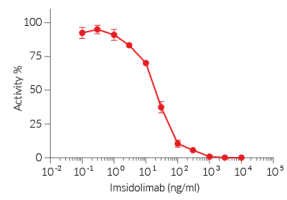
Recombinant human IL-36α can be used together with HEK-Blue™ IL-36 cells for the screening of inhibitory molecules, such as Imsidolimab,a therapeutic monoclonal antibody targeting the IL-36 receptor (see figures).
Key features
- Each lot is validated using HEK-Blue™ IL-36 cells
- Endotoxin ≤ 1 EU/µg (LAL assay)
- 0.2 µm sterile-filtered
Applications
- Standard for IL-36α detection and quantification assays
- Screening and release assays for antibodies blocking IL-36 signaling
- Screening and release assays for engineered IL-36α
Interleukin-36 alpha (IL-36α) belongs to the IL-1 superfamily and is one of the three pro-inflammatory isoforms of IL-36. Dysregulation of IL-36 isoform expression and signaling has been associated with inflammatory diseases such as psoriasis, rheumatoid arthritis, and inflammatory bowel disease.

All products are for internal research use only, and not for human or veterinary use.
Meet the MiniKines™: Collectible Cytokine Cards
SPECIFICATIONS
Specifications
Q9UHA7
100 μg/ml in water
Phosphate buffer saline (pH 7.4), 6% trehalose, 5 mM EDTA, 0.05% Tween 80
The absence of bacterial contamination (e.g. lipoproteins and endotoxins) has been confirmed using HEK-Blue™ TLR2 and HEK‑Blue™ TLR4 cells.
Cellular assays
Each lot is functionally tested and validated.
CONTENTS
Contents
-
Product:Recombinant human IL-36α
-
Cat code:rcyec-hil36a
-
Quantity:10 µg
1.5 ml endotoxin-free water
Shipping & Storage
- Shipping method: Room temperature
- -20°C
- Avoid repeated freeze-thaw cycles
Storage:
Caution:
Details
Interleukin-36 background
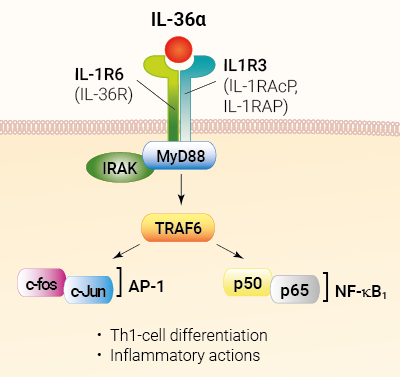
The cytokine interleukin 36 (IL-36) belongs to the IL-1 superfamily. Three isoforms, IL-36α, IL-36β, and IL-36γ, mediate pro-inflammatory functions, while a fourth one, IL-36Ra, acts as an antagonist [1,2]. IL-36 signalization requires the formation of a complex comprised of two subunits, IL-1R6 (aka IL-36R) and IL-1R3 (aka IL-1RAcP, IL-1 receptor accessory protein). The binding of agonist ligands to the IL-36R allows the recruitment of IL-1RAcP and the production of pro-inflammatory cytokines and chemokines through the activation of NF-κB and AP-1 [1,2]. The IL-36Ra antagonist inhibits the signaling by binding to IL-36R and preventing the recruitment of IL-1RAcP [1,2]. IL-36-associated immune response mainly takes place in barrier tissues, such as the skin, lungs, and intestines. Dysregulation of IL-36 isoform expression and signaling has been associated with inflammatory diseases such as psoriasis, rheumatoid arthritis, and inflammatory bowel disease [1,2].
1. Buhl A-L. & Wenzel J., 2019. Interleukin-36 in infectious and inflammatory skin diseases. Front. Immunol. 10(1162). doi: 10.3389/fimmu.2019.01162.
2. Zhou L. & Todorovic V., 2021. Interleukin-36: Structure, Signaling and Function. Protein Reviews: Volume 21. doi: 10.1007/5584_2020_488.
DOCUMENTS
Documents
Technical Data Sheet
Validation Data Sheet
Safety Data Sheet
Certificate of analysis
Need a CoA ?