
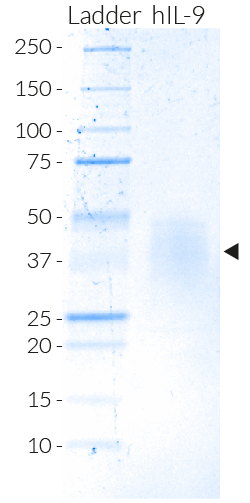

Recombinant human IL-9
-
Cat.code:
rcyc-hil9
- Documents
ABOUT
Human IL-9 protein - Mammalian cell-expressed, tag-free, carrier-free
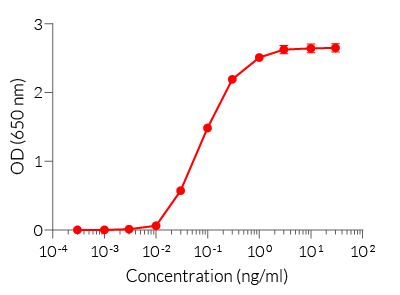
Recombinant human IL-9 is a high-quality and biologically active cytokine, validated using proprietary IL-9 reporter cells. This member of the common γ-chain (γc) receptor cytokine family is produced in CHO cells to ensure protein glycosylation and bona fide 3D structure.
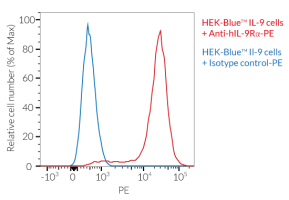
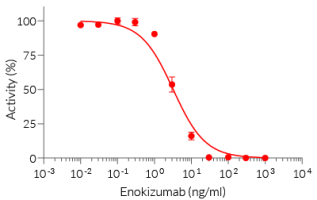
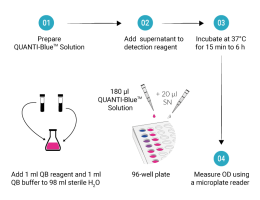
Recombinant human IL-9 can be used together with HEK-Blue™ IL-9 cells for the screening of inhibitory molecules, such as Enokizumab, a therapeutic monoclonal antibody blocking IL-9 signaling (see figures).
Key features
- Each lot is validated using HEK-Blue™ IL-9 cells
- Endotoxin ≤ 0.05 EU/µg
- 0.2 µm sterile-filtered
Applications
- Standard for IL-9 detection and quantification
- Screening and release assays for antibodies blocking IL-9 signaling
- Screening and release assays for engineered IL-9
Interleukin 9 (IL-9) is a secreted cytokine produced by a wide variety of immune cells. IL-9 promotes the survival, proliferation, and activation of mast cells and other immune cells, which are central to the development of allergic reactions and inflammatory diseases, such as asthma and bronchial hyperreactivity.

All InvivoGen products are for internal research use only, and not for human or veterinary use.
Meet the MiniKines™: Collectible Cytokine Cards
SPECIFICATIONS
Specifications
P15248
100 μg/ml in water
Phosphate buffer saline (pH 7.4), 5% saccharose
0.2 µm filtration
The absence of bacterial contamination (e.g. lipoproteins and endotoxins) has been confirmed using HEK-Blue™ TLR2 and HEK‑Blue™ TLR4 cells.
Cellular assays (tested), ELISA
Each lot is functionally tested and validated.
CONTENTS
Contents
-
Product:Recombinant human IL-9
-
Cat code:rcyc-hil9
-
Quantity:10 µg
1.5 ml endotoxin-free water
Shipping & Storage
- Shipping method: Room temperature
- -20 °C
- Avoid repeated freeze-thaw cycles
Storage:
Caution:
Details
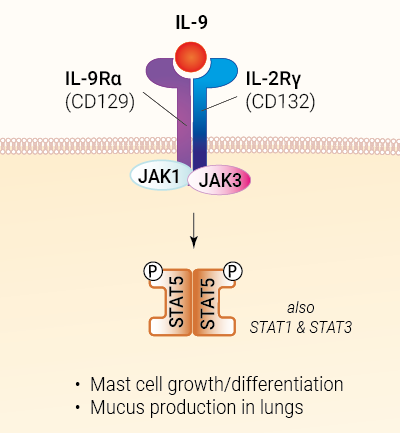
Originally identified as a growth factor of T cells and mast cells, Interleukin-9 (IL-9) is now regarded as a multifunctional cytokine that regulates the function of many different cell types and plays an important role in immunity and immune pathogenesis [1-3]. IL-9 is a secreted cytokine produced by a wide variety of cells, including mast cells, natural killer T (NKT) cells, Th2, Th17, Treg, and Th9 cells. It supports the growth of activated T cell subsets and promotes mast cell proliferation and differentiation [1, 2]. In addition, IL-9 has a direct effect on epithelial cell function, stimulating the production of mucin and T cell chemoattractants [2-4].
IL-9 signals through the heterodimeric cell surface IL-9 receptor (IL-9R) consisting of IL-9Rα (also called CD129) and IL-2Rγ (also called the common γ-chain or CD132). The binding of IL-9 to its receptor triggers three main signaling pathways: JAK/STAT, MAPK, and PI3K [1, 2]. IL-9 is an interesting therapeutic target as it plays a critical role in immunity to parasitic infections, the pathogenesis of cancer and immuno-pathological conditions such as asthma [5, 6].
To date, its main role has been found in the immune responses in allergic diseases, such as asthma and bronchial hyperreactivity. IL-9 promotes the survival, proliferation, and activation of mast cells and other immune cells, which are central to the development of allergic reactions and inflammatory diseases [7].
1. Ritobrata G. & Kaplan M.H., 2011. A brief history of IL-9. J Immunol. 186(6):3283-8.
2. Chakraborty S. et al., 2019. An update on interleukin-9: From its cellular source and signal transduction to its role in immunopathogenesis. Int J Mol Sci. 20(9):2113.
3. Longphre M. et al., 1999. Allergen-induced IL-9 directly stimulates mucin transcription in respiratory epithelial cells. J Clin Invest . 104(10):1375-82.
4. Little F.F. et al., 2001. Il-9 stimulates release of chemotactic factors from human bronchial epithelial cells.Am J Respir Cell Mol Biol . 25(3):347-52.
5. Silva N.S.L. et al., 2021. Interleukin-9 in immunopathology of Trypanosoma cruzi experimental infection. Front Cell Infect Microbiol. 11:756521.
6. Patrussi L. et al., 2021. Interleukin (IL)-9 supports the tumor-promoting environment of chronic lymphocytic leukemia. Cancers (Basel). 13(24):6301.
7. Bick F, et al., 2025. A reappraisal of IL-9 in inflammation and cancer. Mucosal Immunol. (1):1-15.
DOCUMENTS
Documents
Technical Data Sheet
Validation Data Sheet
Safety Data Sheet
Certificate of analysis
Need a CoA ?
 Powered by Bioz