
Anti-hTLR3-hIgG1
-
Cat.code:
htlr3-mab1-2
- Documents
ABOUT
Recombinant Anti-TLR3 Detection Antibody (human IgG1)
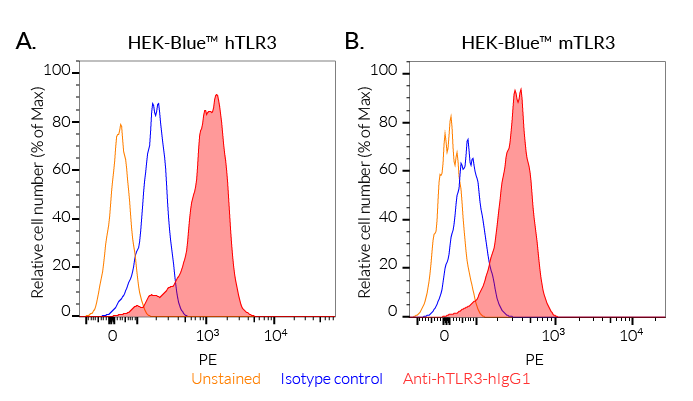
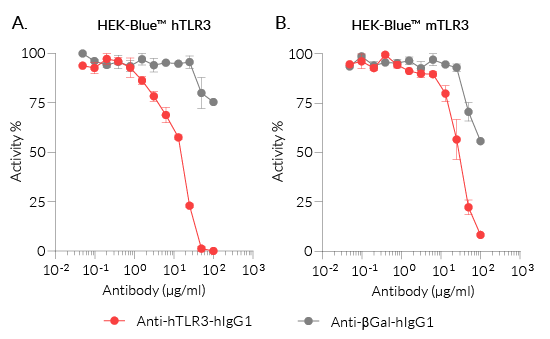
Anti-hTLR3-hIgG1 (clone mAb15) is a recombinant monoclonal antibody, selected for its ability to detect human Toll-like receptor 3 (TLR3) using flow cytometry. It was engineered to feature the variable region of the anti-human TLR3 monoclonal antibody mAb15, which detects the TLR3 ectodomain [1], and a human IgG1 constant region. Of note, the original mAb15 clone is described to efficiently neutralize TLR3 activity using cellular assays [1].
Anti-hTLR3-hIgG1 is produced in Chinese hamster ovary (CHO) cells and purified by affinity chromatography.
Anti-hTLR3-hIgG1 cross-reacts with mouse TLR3 (see figure).
Key features:
- Detects human and mouse TLR3 (flow cytometry)
- Provided azide-free
- Each lot is functionally tested
TLR3 is an important pattern recognition receptor (PRR) that recognizes double-stranded (ds)RNA, a hallmark of viral replication, and triggers antiviral NF-κB and IRF immune responses.

1. Luo J., et al., 2012. Lateral clustering of TLR3:dsRNA signaling units revealed by TLR3ecd:3Fabs quaternary structure. J Mol Biol., 421(1):112.
All InvivoGen's products are for internal research use only, and not for human or veterinary use.
SPECIFICATIONS
Specifications
TLR3
Human
Mouse TLR3
Flow cytometry (tested), Neutralization (tested)
TRIS buffer with glycine, saccharose, and stabilizing agents
0.22 µm filtration
Negative (tested using EndotoxDetect™ assay)
Each lot is functionally tested and validated.
CONTENTS
Contents
-
Product:Anti-hTLR3-hIgG1
-
Cat code:htlr3-mab1-2
-
Quantity:2 x 100 µg
Shipping & Storage
- Shipping method: Room temperature
- -20°C
- Avoid repeated freeze-thaw cycles
Storage:
Caution:
Details
Toll-Like Receptor 3
In humans, four Toll-Like Receptor (TLR) family members, TLR3, TLR7, TLR8, and TLR9, are specialized in sensing viral-derived components and are mainly found in the endosome. Among these, TLR3 recognizes double-stranded (ds)RNA, a hallmark of viral replication, and triggers antiviral immune responses [1]. TLR3 is expressed in myeloid dendritic cells, macrophages, as well as non-immune cells [2].
TLR3 signaling
TLR3 activation upon viral infection involves several steps, including translocation of TLR3 from the ER (endoplasmic reticulum) via the Golgi to the endosome, proteolytic cleavage and dimerization of TLR3, and finally receptor-ligand binding [3]. To start the signaling cascade, activated TLR3 recruits the adaptor protein TRIF (TIR domain-containing adapter-inducing interferon-β). TRIF binds to TRAF3 (TNF receptor-associated factor 3), which then recruits TBK1 (TANK-binding kinase 1) and IKKε (IκB kinase ε), thus activating the transcription factor IRF3 (interferon regulatory factor 3) and stimulating the production of type I IFNs (interferons). Additionally, TRIF interacts with TRAF6 and RIP1 (kinase receptor-interacting protein 1). RIP1 in turn binds to TAK1 (transforming growth factor β-activated kinase 1) and IKK. TAK1 phosphorylates IKKα and IKKβ, leading to the phosphorylation of IκB, the NF-κB inhibitor. Ultimately, this leads to the release and translocation of NF-κB into the nucleus and the induction of pro-inflammatory cytokines [2,4].
Pathology
Given its important role in dsRNA recognition, TLR3 signaling has been intensively studied. Various TLR3-agonists, such as the synthetic dsRNA analog Poly(I:C) are being used in vaccine development and cancer therapy [4]. Yet, recent studies have indicated that TLR3 may act as a double-edged sword by showing both protective and damaging functions in the context of some human viral infections [3,5]. Moreover, rare mutations in TLR3 have been associated with viral susceptibility; specifically, infections with HSV-1 (herpes simplex virus 1), influenza, and SARS-Co-V2 have been linked to pathogenic germline variants in TLR3 pathway genes [2]. Understanding the TRIF-dependent TLR3 pathway may be essential for the establishment of specific therapeutic approaches to diminish TLR3-driven disease and exploit its protective functions [3].
References
1. Manuela Sironi, et al., 2012. A Common Polymorphism in TLR3 Confers Natural Resistance to HIV-1 Infection. J Immunol 15; 188 (2): 818–823.
2. Aluri, J, et al., 2021. Toll-Like Receptor Signaling in the Establishment and Function of the Immune System. Cells, 10, 1374.
3. Chen Y, et al., 2021. Toll-like receptor 3 (TLR3) regulation mechanisms and roles in antiviral innate immune responses. J Zhejiang Univ Sci B.;22(8):609-632.
4. Komal A, et al., 2021. TLR3 agonists: RGC100, ARNAX, and poly-IC: a comparative review. Immunol Res. 69(4):312-322.
5. Perales-Linares R, Navas-Martin S. 2013. Toll-like receptor 3 in viral pathogenesis: friend or foe? Immunology.;140(2):153-67.
DOCUMENTS
Documents
Technical Data Sheet
Validation Data Sheet
No ressource available.
Certificate of analysis
Need a CoA ?


 Powered by Bioz