

Zymosan Depleted
-
Cat.code:
tlrl-zyd
- Documents
ABOUT
Hot alkali-treated zymosan
Depleted zymosan is a purified β-glucan–enriched preparation generated by subjecting zymosan, an insoluble Saccharomyces cerevisiae cell-wall extract, to hot alkali treatment. This process selectively removes TLR2-stimulating components, including mannoproteins, phospholipannans, and other alkali-labile cell-wall constituents, while preserving the underlying β-(1→3)/(1→6)-glucan scaffold. As a result, depleted zymosan retains its ability to robustly engage the C-type lectin receptor Dectin-1, leading to Syk–CARD9–dependent signaling, but exhibits minimal to no activation of TLR2 [1,2]. This makes depleted zymosan a valuable tool for dissecting Dectin-1–specific immune responses, studying β-glucan recognition, and distinguishing CLR-mediated signaling from concomitant TLR-driven pathways typically triggered by native zymosan.
Depleted zymosan offers several advantages as a Dectin-1 agonist: as a particulate β-glucan, it is efficiently phagocytosed, closely mimics the architecture of real fungal particles, and promotes the receptor clustering and phagocytic signaling events that soluble ligands are unable to induce. Recent studies support these properties: Cheng et al. (2024) showed that depleted zymosan elicits Dectin-1–dominated signaling and innate immune training profiles comparable to purified β-glucans [3], while Anaya et al. (2023) demonstrated that particulate β-glucan structure is essential for effective Dectin-1 multimerization and downstream activation [4].
Key features
- Selective Dectin-1 agonist
- Particulate β-glucan–rich preparation
- Each lot is functionally tested using Dectin-1 reporter cells
Applications
- Studying Dectin-1–specific signaling pathways
- Investigating β-glucan–dependent phagocytosis and receptor clustering
- Innate immune training and functional reprogramming
- Comparative studies of β-glucan ligands
- CLR–TLR crosstalk analysis
References:
1. Gantner BN. et al., 2003. Collaborative induction of inflammatory responses by dectin-1 and Toll- like receptor 2. J Exp Med. 197(9):1107-17.
2. Ikeda Y. et al., 2008. Dissociation of Toll-like receptor 2-mediated innate immune response to Zymosan by organic solvent-treatment without loss of Dectin-1 reactivity. Biol Pharm Bull.31(1):13-8.
3. Cheng QJ. et al., 2024. Dectin-1 ligands produce distinct training phenotypes in human monocytes through differential activation of signaling networks. Sci Rep 14(1):1454
4. Anaya EU. et al., 2023. Dectin-1 multimerization and signaling depends on fungal β-glucan structure and exposure. Biophys J. 122(18):3749-3767.
All products are for internal research use only, and not for human or veterinary use.
SPECIFICATIONS
Specifications
100 µg/ml
Dectin-1 activation in cellular assays
Each lot is functionally tested and validated.
CONTENTS
Contents
-
Product:Zymosan Depleted
-
Cat code:tlrl-zyd
-
Quantity:10 mg
10 ml sterile endotoxin-free water
Shipping & Storage
- Shipping method: Room temperature
- -20°C
- Avoid repeated freeze-thaw cycles
Storage:
Caution:
Details
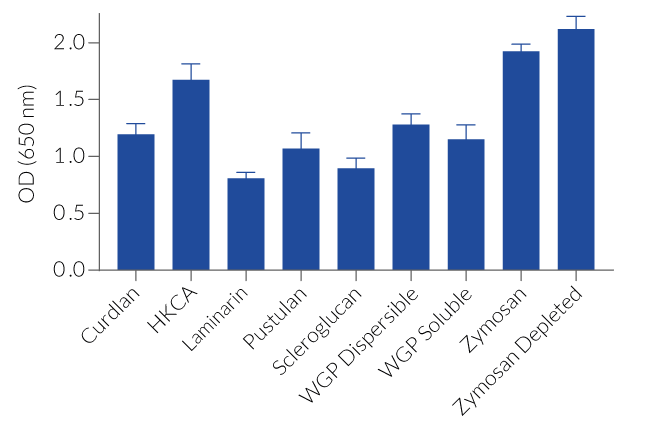
Zymosan depleted was obtained by treating zymosan with hot alkali to remove all its TLR-stimulating properties. Zymosan depleted activates Dectin-1 but not TLR2. Dectin-1, which is expressed on phagocytes, is a specific receptor for β-glucans [1]. β-Glucans are glucose polymers found in the cell walls of fungi, such as zymosan (a cell wall preparation of Saccharomyces cerevisiae) and Candida albicans. Dectin-1 binds and internalizes β-glucans and mediates the production of reactive oxygen species (ROS), activation of NF-κB and subsequent secretion of proinflammatory cytokines. However, it is now clear that its β-glucan moiety triggers NF-κB activation only through Dectin-1 as treatment with hot alkali or organic solvents abrogates the TLR2-dependent response [2,3]. RAW-Blue™ cells express high levels of endogenous Dectin-1 and therefore can be used as a Dectin-1 reporter cell line. Stimulation of RAW-Blue™ cells with zymosan depleted or heat-killed preparations of yeast induces the activation of NF-κB in a Dectin-dependent manner. NF-κB activation can be readily monitored as RAW-Blue™ cells stably express an NF- κB-inducible SEAP reporter gene.
References:
1. Brown GD. et al., 2003. Dectin-1 mediates the biological effects of beta-glucans. J Exp Med. 197( 9): 1119- 24.
2. Gantner BN. et al., 2003. Collaborative induction of inflam- matory responses by dectin-1 and Toll- likereceptor 2. J Exp Med. 197( 9): 1107- 17.
3. ikeda Y. et al., 2008. Dissociation of Toll- like receptor 2-mediated innate immune response to Zymosan by organic solvent-treatment without loss of Dectin-1 reactivity.Biol Pharm Bull.31( 1): 13-8.
DOCUMENTS
Documents
Technical Data Sheet
Safety Data Sheet
Certificate of analysis
Need a CoA ?
 Powered by Bioz