

pUNO1-hSTING-A162
-
Cat.code:
puno1-hsting-a162
- Documents
ABOUT
Expression-ready ORF Clones
Human STING gene, S162A variant
STING (stimulator of interferon genes; also known as TMEM173, MITA, MPYS, and ERIS) is essential for the IFN response to microbial or self-DNA, and acts as a direct sensor of cyclic dinucleotides (CDNs).
CDNs are important messengers in bacteria, affecting numerous responses of the prokaryotic cell, but also in mammalian cells, acting as agonists of the innate immune response.
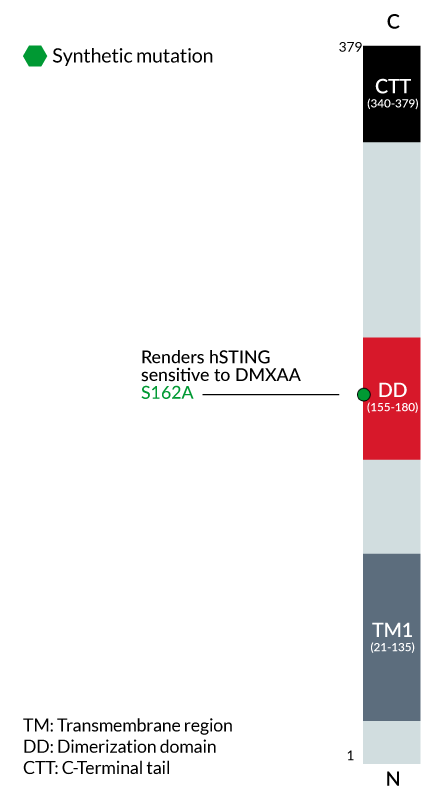
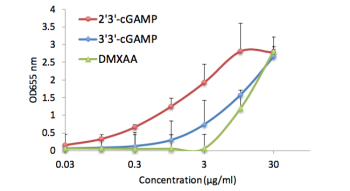
Human wild-type STING fails to bind DMXAA, a potent tumor vascular disrupting agent in mice [1]. The allele A162 contains a unique point mutation (S162A) placed at the cyclic-dinucleotide-binding site which confers DMXAA sensitivity to hSTING [2].
References:
1. Conlon J. et al., 2013. Mouse, but not human STING, binds and signals in response to the vascular disrupting agent 5,6-dimethylxanthenone-4-acetic acid. J Immunol 190(10):5216-25.
2. Gao P. et al., 2013. Structure-function analysis of STING activation by c[G(2',5')pA(3',5')p] and targeting by antiviral DMXAA. Cell 154(4):748-62.
All products are for research use only, and not for human or veterinary use.
SPECIFICATIONS
Specifications
Plasmid construct has been confirmed by restriction analysis and full-length open reading frame (ORF) sequencing.
CONTENTS
Contents
-
Product:pUNO1-hSTING-A162
-
Cat code:puno1-hsting-a162
-
Quantity:20 µg
2 x 1 ml blasticidin at 10 mg/ml
Shipping & Storage
- Shipping method: Room temperature
- -20°C
- Avoid repeated freeze-thaw cycles
Storage:
Caution:
DOCUMENTS
Documents
Technical Data Sheet
Plasmid Sequence
Safety Data Sheet
Certificate of analysis
Need a CoA ?


 Powered by Bioz