

Chloroquine
-
Cat.code:
tlrl-chq-4
- Documents
ABOUT
Endosomal acidification and autophagy inhibitor
Chloroquine is a lysosomotropic agent that was historically developed as an anti-malarial treatment. However, it has become a widely used inhibitor for studying autophagy and the role of endosomal acidification in cellular processes, such as in intracellular TLR9 signaling.

Mode of action:
Chloroquine passively diffuses into cellular acidic compartments, including endosomes, Golgi vesicles, and lysosomes, where it accumulates as a protonated form. This results in an increase of the intravesicular pH, and the inhibition of several enzymes that require an acidic pH for proper functioning. Thus, chloroquine prevents the maturation and fusion of endosomes and lysosomes [1].
Key features:
- Extensively used in the literature as an endosomal acidification and autophagy inhibitor
- InvitroFit™ grade: highly pure (≥98%) and inhibitory function validated in cellular assays
References:
1. Ducharme J. & Farinotti, R., 1996. Clinical pharmacokinetics and metabolism of chloroquine. Focus on recent advancements. Clin Pharmacokinet 31, 257-274.
All products are for research use only, and not for human or veterinary use.

InvitroFit™
InvitroFit™ is a high-quality standard specifically adapted for in vitro studies of inhibitors. InvitroFit™ products are guaranteed free of bacterial contamination, as confirmed using HEK Blue™ TLR2 and HEK Blue™ TLR4 cellular assays. Each lot is rigorously tested for functional activity using validated (or proprietary) cellular models. This grade ensures reliability and reproducibility for your research applications.
SPECIFICATIONS
Specifications
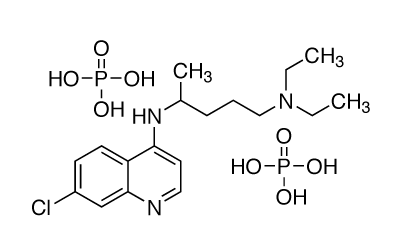
C18H26ClN3 •2H3PO4
50 mg/ml in water
10 μM
Negative (tested using EndotoxDetect™ assay)
In vitro cellular assays
Each lot is functionally tested and validated using cellular assays.
CONTENTS
Contents
-
Product:Chloroquine
-
Cat code:tlrl-chq-4
-
Quantity:4 x 250 mg
Shipping & Storage
- Shipping method: Room temperature
- 15-25°C (room temperature)
- Protect from light
Storage:
Caution:
Details
Chloroquine has an extensive range of biological effects. Due to its well-studied toxicity profile, chloroquine is one of the only autophagy inhibitors approved for use in the clinic [1]. Modulation of autophagy by chloroquine has been shown to have the potential in delaying the onset and/or enhancing therapies for various pathologies such as cancer, chronic obstructive pulmonary disease (COPD), and inflammatory diseases. Specifically, it has been shown, in vitro and in vivo, that chloroquine has a detrimental effect on the basal autophagic flux by decreasing autophagosome-lysosome fusion due to the impaired function of essential hydrolases [2].
Chloroquine impairs the replication of several viruses, including members of flaviviruses, retroviruses, and coronaviruses, by inhibiting the necessary endosome acidification upon endosomal-mediated viral entry and vesicle trafficking in the later stages of infection (i.e. through the ER-Golgi and exocytosis from the cell) [3, 4]. A subset of Toll-like receptors (TLRs), TLR3, TLR7/8, and TLR9, is involved in antiviral responses by triggering the production of antiviral cytokines such as type I interferons (IFNs). TLR3 responds to double-stranded RNA, a replication intermediary for many viruses. TLR7/8 recognize viral single-stranded RNAs, whereas TLR9 recognizes unmethylated CpG motifs within viral DNA [5]. Of note, the TLRs involved in virus recognition are expressed on endosomal membranes.
Notably, chloroquine is used routinely in the clinic for inflammatory conditions such as rheumatoid arthritis (RA) and systemic lupus erythematosus (SLE) [6]. The accumulation of chloroquine in lymphocytes and macrophages decreases the production of pro-inflammatory cytokines, specifically TNF-α, and results in anti-inflammatory properties [3].
References:
1. Solitro A.R. & MacKeigan J.P., 2016. Leaving the lysosome behind: novel developments in autophagy inhibition. Future Med Chem. 8(1):73-86.
2. Mauthe M. et al., 2018. Chloroquine inhibits autophagic flux by decreasing autophagosome-lysosome fusion. Autophagy 14(8):1435-1455.
3. Savarino A. et al., 2003. Effects of chloroquine on viral infections: an old drug against today's diseases? Lancet Infect Dis 3, 722-727.
4. Wang M. et al., 2020. Remdesivir and chloroquine effectively inhibit the recently emerged novel coronavirus (2019-nCoV) in vitro. Cell Res 30, 269-271.
5. Boehme KW. & Compton T., 2004.Innate sensing of viruses by toll-like receptors. J Virol 78, 7867-7873.
6. Al-Bari M.A., 2015. Chloroquine analogs in drug discovery: new directions of uses, mechanisms of actions, and toxic manifestations from malaria to multifarious diseases. J Antimicrob Chemother 70, 1608-1621.
Chemical structure of Chloroquine (diphosphate)
DOCUMENTS
Documents
Technical Data Sheet
Validation Data Sheet
Safety Data Sheet
Certificate of analysis
Need a CoA ?


 Powered by Bioz