CPPD crystals
-
Cat.code:
tlrl-cppd
- Documents
ABOUT
NLRP3 Inflammasome Inducer - Calcium Pyrophosphate Dihydrate crystals
Calcium pyrophosphate dihydrate (CPPD) crystals are the aetiological agent of the joint acute inflammatory disease pseudogout. Notably, research has demonstrated that CPPD crystals trigger the NLRP3 inflammasome-dependent induction of interleukin-1β (IL-1β) and IL-18 [1].

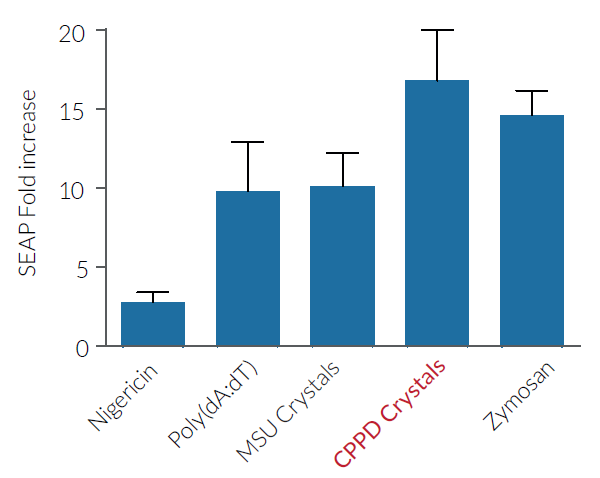
The biological activity of CPPD crystals has been validated using InvivoGen's HEK-Blue™ IL-1β cells and THP1-HMGB1-Lucia™ cells.
Key features:
- Potent inducer of the NLRP3 inflammasome
- Each lot is functionally tested
 Read our review on the NLRP3 inflammasome.
Download our Practical guide on Inflammasomes.
Reference:
1. Martinon F. et al., 2006. Gout-associated uric acid crystals activate the NALP3 inflammasome. Nature. 440(7081):237-41.
All products are for research use only, and not for human or veterinary use.

InvivoGen also offers:
SPECIFICATIONS
Specifications
1 - 50 µg/ml
Insoluble
Cellular assays
Each lot is functionally tested and validated.
CONTENTS
Contents
-
Product:CPPD crystals
-
Cat code:tlrl-cppd
-
Quantity:5 mg
5 mg calcium pyrophosphate dihydrate (CPPD) crystals
Shipping & Storage
- Shipping method: Room temperature
- 4°C
- Avoid repeated freeze-thaw cycles
Storage:
Caution:
Details
Similar to uric acid, the causative agent of gout, CPPD crystals can act as endogenous danger signals that stimulate the innate immune system to produce inflammatory cytokines such as IL-1β. Engagement of the NRLP3 inflammasome is supported by the finding that macrophages from mice deficient in various components of the inflammasome did not respond to injection of CPPD crystals [1].
The NLRP3 inflammasome is an intracellular multi-protein complex that plays a central role in innate immunity. It is activated by a two-step process. A first signal (‘priming’) is provided by pathogen-associated molecular patterns (PAMPs) or cytokines. It allows the transcriptional upregulation of key inflammasome actors and the post-translational modification of NLRP3 . The second signal (‘activation’) is provided by a wide array of stimuli including microbial toxins, endogenous molecules or crystalline substances. The current paradigm is that NLRP3 does not bind directly to these molecules. Rather it senses downstream cytosolic stress signals such as K+ efflux. This triggers inflammasome multimerization and pro-caspase-1 maturation. Proximity-induced autolytic activation of caspase-1 leads to the formation of gasdermin D (GSDMD) pores at the cell surface, allowing IL-1β/IL-18 and alarmin secretion, and ultimately, pyroptosis [3,4].
References:
1. Martinon F. et al., 2006. Gout-associated uric acid crystals activate the NALP3 inflammasome. Nature. 440(7081):237-41
2. Swanson K.V. et al., 2019. The NLRP3 inflammasome: molecular activation and regulation to therapeutics. Nat. Rev. Immunol. 19:477.
3. Groslambert M. & Py B. 2018. Spotlight on the NLRP3 inflammasome pathway. J. Inflamm. Res. 11:359.
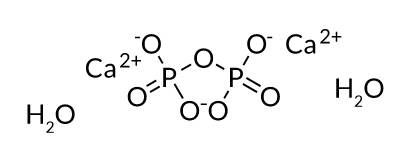
Chemical structure of CPPD Crystals:
DOCUMENTS
Documents
Technical Data Sheet
Validation Data Sheet
Safety Data Sheet
Certificate of analysis
Need a CoA ?
 Powered by Bioz