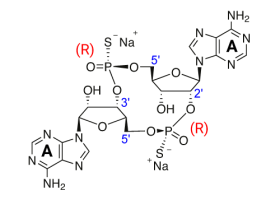
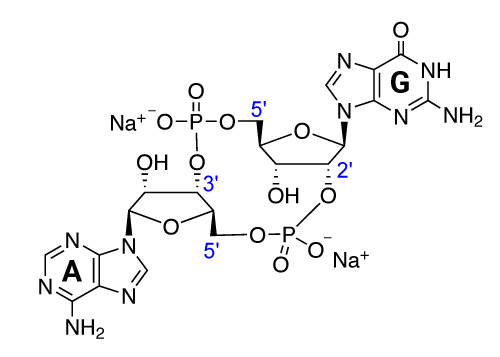


2’3’-cGAMP
-
Cat.code:
tlrl-nacga23-02
- Documents
ABOUT
2'3'-cGAMP mammalian cyclic di-nucleotide - STING ligand
2’3’-cGAMP is a cyclic dinucleotide (CDN) that potently activates STING (stimulator of interferon genes). It is referred to as “noncanonical“ cGAMP due to the presence of the atypical 2’-5’ phosphodiester linkage between guanosine and adenosine. STING activation by 2’3’-cGAMP induces type I interferons (IFNs) and pro-inflammatory cytokines [1, 2]. STING is an endoplasmic adaptor and sensor protein that is paramount in innate immunity.

Mode of action:
2’3’-cGAMP (cyclic [G(2’,5’)pA(3’,5’)p]) is produced in mammalian cells by cGAS (cGAMP synthase) in response to double-stranded DNA in the cytoplasm. Similar to the canonical 3’3’-cGAMP, 2’3’-cGAMP serves as a second messenger to activate innate immune responses by binding to and activating STING. Upon activation, STING induces type I IFNs, via the TANK-binding kinase 1 (TBK1)/ interferon regulatory factor 3 (IRF3) pathway [1], and pro-inflammatory cytokines, via the NF-κB pathway [1, 2].
Structural and functional studies revealed that 2’3’-cGAMP is distinct from the canonical 3’3’-cGAMP produced by bacteria [3, 4]. 2'3'-cGAMP binds to STING with a much greater affinity than 3'3'-cGAMP [1]. Interestingly, certain variants of STING are able to distinguish between noncanonical and canonical cGAMP [3].
Key features of 2’3’-cGAMP:
- Potent STING agonist
- Noncanonical CDN
- Each lot is highly pure (≥95%) and functionally tested
 Read our review on STING: Deciphering the STING Paradox
References:
1. Zhang X. et al., 2013. Cyclic GMP-AMP containing mixed phosphdiester linkages is an endogenous high-affinity ligand for STING. Mol Cell.51(2):226-35.
2. Abe T. & Barber G.N., 2014. CytosolicDNA-mediated, STING-dependent proinflammatory gene induction necessitates canonical NF-κB activation through TBK1. J Virol. 88(10):5328-41.
3. Diner E. et al., 2013. The Innate Immune DNA Sensor cGAS Produces a Noncanonical Cyclic Dinucleotide that Activates Human STING. Cell Rep. 3(5):1355-61.
4. Gao P. et al., 2013. Cyclic [G(2',5')pA(3',5')p] is the metazoan second messenger produced by DNA-activated cyclic GMP-AMP synthase. Cell. 153(5):1094-107.
All InvivoGen products are for research use only, and not for human or veterinary use.
Also available:
High-quality pre-clinical grade
SPECIFICATIONS
Specifications
C20H22N10O13P2 •2Na
0.1 - 100 µg/ml
50 mg/ml in water
0.22 µm filtration
The absence of bacterial contamination (e.g. lipoproteins and endotoxins) is confirmed using HEK-Blue™ TLR2 and HEK-Blue™ TLR4 cells.
Induction of ISG and NF-κB pathways in cellular assays
Each lot is released only after meeting predefined biological activity specifications in a cell-based assay.
CONTENTS
Contents
-
Product:2’3’-cGAMP
-
Cat code:tlrl-nacga23-02
-
Quantity:200 µg
1.5 ml endotoxin-free water
Shipping & Storage
- Shipping method: Room temperature
- -20°C
- Avoid repeated freeze-thaw cycles
Storage:
Caution:
Details
STING
The STimulator of INterferon Genes STING, alternatively known as MPYS, TMEM173, MITA, and ERIS, is a key sensor of cytosolic nucleic acids. Initially thought to serve solely as an adaptor protein for mediating signaling by cytosolic DNA sensors (CDS), STING was found to be a direct sensor of cyclic dinucleotides (CDNs) [1].
STING signaling
CDNs are ubiquitous second-messenger molecules in bacterial or metazoal signal transduction and are defense triggers in mammalian cells. Namely, cyclic diguanylic acid (c-di-GMP), cyclic diadenylic acid (c-di-AMP), and cyclic adenylicguanylic acid (cGAMP) are the most prevalent intracellular signaling intermediates in bacteria and/or metazoa [2-3].
A direct interaction between DNA and STING could not be demonstrated, suggesting the intervention of at least one additional protein [1]. The identity of the major dsDNA cytosolic sensor was resolved in 2013: cGAs (cyclic GMP-AMP synthase) is activated upon direct DNA binding and subsequently catalyzes the production of a non-canonical cGAMP, which in turn, activates STING [3].
Once activated, STING and TANK-binding-kinase-I (TBK1) interact to induce an active interferon regulatory factor (IRF3) dimer which then binds to interferon-stimulated responsive elements (ISRE) in the nucleus and leads to IFN-α/β production [4]. The production of NF-κB-dependent inflammatory cytokines is also observed downstream of STING activation but the underlying mechanisms remain opaque [5].
References:
1. Burdette DL. et al., 2011. STING is a direct innate immune sensor of cyclic di-GMP. Nature 478(7370):515-8.
2. Woodward JJ. et al., 2010. c-di-AMP secreted by intracellular Listeria monocytogenes activates a host type I interferon response. Science 328(5986):1703-5.
3. Wu J. et al., 2013. Cyclic GMP-AMP is an endogenous second messenger in innate immune signaling by cytosolic DNA. Science, 339(6121):826-30.
4. Ishikawa H. et al., 2009. STING regulates intracellular DNA-mediated, type I interferon-dependent innate immunity. Nature 461: 788-92.
5. Abe T. and Barber G.N., 2014. Cytosolic-DNA-Mediated, STING-Dependent Proinflammatory Gene Induction Necessitates Canonical NF-κB Activation through TBK1. Journal of Virology 88:5328-41.
DOCUMENTS
Documents
Technical Data Sheet
Validation Data Sheet
Safety Data Sheet
Certificate of analysis
Need a CoA ?
 Powered by Bioz