Mycoplasmas are the smallest and simplest self-replicating organisms. Due to their minimal genome, they cannot perform metabolic functions such as production of a cell wall, or synthesis of nucleotides or amino acids. Therefore, they exist strictly as parasites, using diverse organisms as hosts, including humans, animals, insects and plants.
Mycoplasma and Acholeplasma
Mycoplasma and Acholeplasma are genera that comprise more than 100 recognized species in the class Mollicutes, which are bacteria that lack a cell wall. Among these, about 20 species have been described to be contaminants of eukaryotic cell cultures. However, five species (Mycoplasma [M.] arginini, M. fermentans, M. orale, M. hyorhinis and Acholeplasma laidlawii) are isolated in 90-95% of contaminated cell cultures[1].
The mycoplasmas that contaminate cell cultures come from three principal sources: incoming infected cells, such as those donated by other labs; laboratory personnel, who are potential carriers of M. orale, M. fermentans, M. salivarium and/or M. hominis; and cell culture reagents such as bovine sera (M. arginine and A. laidlawii) or porcine trypsin (M. hyorhinis). Once an area has become contaminated, the mycoplasmas can spread by aerosol droplet dispersion. Therefore, Good Laboratory Practices must be followed to prevent contamination or at least, to stop existing contaminations from spreading. This includes regular disinfection of all workspaces, cell-culture storage areas and equipment (pipettes, laminar flow hoods, incubators, etc.)[2].
Mycoplasma contamination
Mycoplasma contamination of cells often goes unperceived. Unlike bacteria or fungi, mycoplasmas do not cause consistently observable alterations in cell culture such as rapid pH change or culture turbidity[2,4]. Furthermore, although mycoplasmas can grow to very high concentrations (typically 106/mL to 108/mL), due to their small size (0.1 µm to 0.8 µm in diameter) they remain invisible to the naked eye and undetectable by light microscopy. Nevertheless, mycoplasmas can have disastrous effects on eukaryotic cells, as they can alter every cellular function (proliferation, protein synthesis, susceptibility to viral infection, etc.).
Mycoplasma detection in cell culture
The only way to confirm mycoplasma contamination is by routine testing using one or more special techniques, including direct growth on broth/agar, specific DNA staining, PCR, ELISA, RNA labeling and enzymatic procedures. However, none of these methods is 100% reliable; thus, for optimal efficacy, multiple methods are often used in parallel. Direct growth methods are relatively sensitive to most species but the overall procedure is lengthy (3 weeks), costly and less sensitive to non-cultivable species. Specific DNA staining procedures are relatively quick and are easy to perform, but their results can often be difficult to interpret, especially due to decomposition of contaminant nucleic acids. The PCR method, although rather fast and inexpensive, requires stringent assay-setup to avoid the risk of false positives or negative results due to contamination with target DNA or inhibition of Taq DNA polymerase[5].
Enzymatic conversion of ADP to ATP can be detected by luciferase-containing kits but requires expensive luminometric equipment and can generate false negatives due to impaired enzyme function[6] or to false positives from eukaryotic ATP in the cell culture medium[5].
The key to mycoplasma testing is frequency. Contamination happens quickly and spreads fast, so labs that rely on cell cultures must test them regularly. Since research organizations have limited personnel and must deal with compliance issues, InvivoGen has developed a simple and practical mycoplasma detection kit, PlasmoTest™, which sits right in the incubator alongside cells. It enables more frequent testing and thus, helps reduce the risk of contamination.
PlasmoTest™ is based on detection of mycoplasmas by engineered cells that express Toll-like receptor 2 (TLR2), a pathogen recognition receptor that detects bacterial membranes components. TLR2 is highly conserved from Drosophila to humans and, to date, there have not been any reports of a mycoplasma strain able to go undetected by TLR2. Thus, PlasmoTest™ can detect any type of mycoplasma in your cell cultures. This universal sensitivity, combined with an easy-to-use format, makes PlasmoTest™ a reliable, simple and cost-effective product for routine testing of all cell cultures at risk of contamination.
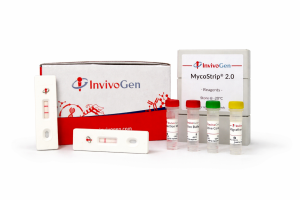
InvivoGen also offers a new method for the detection of mycoplasma in cell culture, allowing you to combat the contamination : MycoStrip®, for immediate detection of mycoplasma contamination in cell cultures. MycoStrip® is a simple and rapid test based on isothermal PCR. The results are clearly visualized as a band on an immunochromatic strip.
References:
1. McGarrity G. et al., 1992. Mycoplasmas and tissue culture cells. In: Maniloff, J., McElhaney, R.N., Finch, L.R., Baseman, J.B. (Eds.), Mycoplasmas, Molecular Biology and Pathogenesis, American Society for Microbiology, Washington DC, pp.445-54.
2. Lincoln CK,Gabridge MG., 1998. Cell culture contamination: sources, consequences, prevention, and elimination. Methods Cell Biol. 57: 49-65.
3. Razin S. et al., 1998. Molecular biology and pathogenicity of mycoplasma. Microbiol Mol Biol Rev. 62: 1094-1156.
4. Doyle A, Griffiths JB., 1998. The cell: selection and standardization. In: Cell and tissue culture: laboratory procedures in biotechnology. Doyle, A and Griffiths JB, Wiley and Sons, Ltd.35-52.
5. Uphoff CC et al., 2014 Detection of Mycoplasma contamination in cell cultures. Curr Protoc Mol Biol. 2014 Apr 14;106:28.4.1-14.
6. Molla Kazemiha V. et al., 2012. Sensitivity of biochemical test in comparison with other methods for the detection of mycoplasma contamination in human and animal cell lines stored in the National Cell Bank of Iran. Cytotechnology. Oct;66(5):861-73.