



pVAC
| Product | Unit size | Cat. code | Docs. | Price | |
|---|---|---|---|---|---|
|
pVAC1-mcs Expression plasmids for induction of neutralizing antibodies |
Show product |
20 µg |
pvac1
|
||
|
pVAC2-mcs Expression plasmids for induction of neutralizing antibodies |
Show product |
20 µg |
pvac2
|
Expression plasmids for induction of neutralizing antibodies
pVAC is a DNA vaccine plasmid designed to stimulate a humoral immune response by intramuscular injection.
Antigenic proteins are targeted and anchored to the cell surface by cloning the gene of interest in frame upstream of the C-terminal transmembrane anchoring domain of placental alkaline phosphatase.
The antigenic peptide produced on the surface of muscle cells is thought to be taken up by antigen presenting cells (APCs) and processed through the major histocompatibility complex (MHC) class II pathway.
Two pVAC backbones are available, pVAC1-mcs for the cloning of an antigenic gene that is not naturally secreted and pVAC2-mcs for the cloning of an antigenic gene that possesses a signal sequence.
References:
1. Corr M. et al. 1999. In vivo priming by DNA injection occurs predominantly by antigen transfer. J Immunol. 163(9):4721-7.
2. Forns X. et al. 1999. DNA immunization of mice and macaques with plasmids encoding hepatitis C virus envelope E2 protein expressed intracellularly and on the cell surface. Vaccine 17:1992-2002.
3. McCluskie MJ et al. 1999. Route and method of delivery of DNA vaccine influence immune responses in mice and non-human primates. Mol Med 5:287-300.
Specifications
High-level and Sustained Expression of the Antigenic Gene
Convenient Cloning of the Antigenic Gene
Cell Surface Expression of the Antigenic Protein
Selectable with Zeocin™ in E. coli
Back to the topContents
- 20 µg of lyophilized DNA
- 1 ml of Zeocin™ (100 mg/ml)
 Product is shipped at room temperature
Description
High-level Expression of the Antigenic Gene
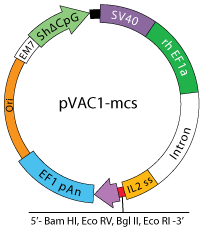
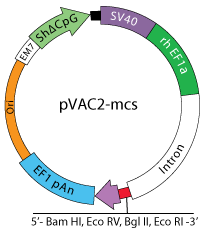
pVAC plasmids utilize the promoter region of the rhesus monkey EF1α gene to achieve high levels of expression in skeletal muscle cells and antigen presenting cells.
Expression levels are further increased by the addition of the SV40 enhancer that heightens the ability of the plasmid to be transported into the nucleus, especially in non-dividing cells.
Sustained Expression of the Antigenic Gene
The bacterial region required for replication and selection of pVAC in E. coli contains a reduced number of immunogenic CpG motifs by featuring a minimized origin of replication (Ori) and a CpG-free Zeocin™-resistance gene (Sh-ΔCpG) .
Convenient Cloning of the Antigenic Gene
pVAC plamids contain multiple cloning site (MCS) ith several commonly used restriction sites.
pVAC1-mcs 5'- Bam HI, Eco RV, Bgl II, Eco RI -3'
pVAC2-mcs 5'- Bam HI, Eco RV, Bgl II, Eco RI -3'
Cell Surface Expression of the Antigenic Protein
Two pVAC backbones are available:
- pVAC1-mcs is designed for the cloning of an antigenic gene that is not naturally secreted. The MCS is flanked by the 5' IL2 signal sequence and the 3' glycosylphosphatidylinositol (GPI) anchoring domain of human placental alkaline phosphatase (PLAP).
- pVAC2-mcs is designed for the cloning of an antigenic gene that already possesses a signal sequence. The MCS is located upstream of the GPI anchoring domain of human PLAP.